B Pharm · PCI syllabus · Handwritten PDF notes
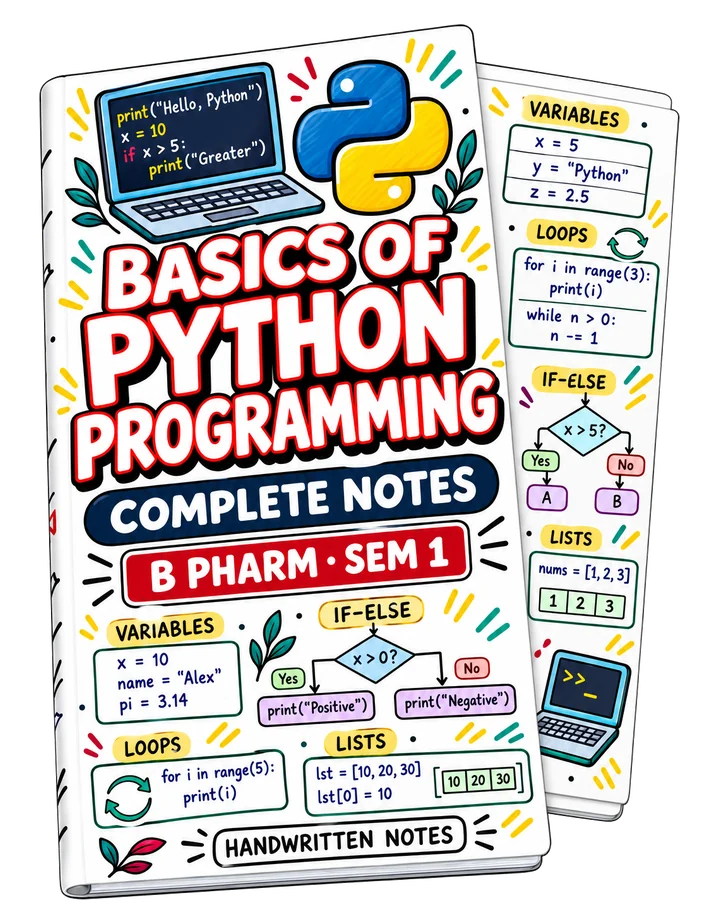
B Pharm Semester 1Basics of Python Programming Notes
Instant PDF download after payment. Pay once, keep forever.
- Instant download
- Lifetime access
- UPI, GPay, PhonePe, cards
Watch before you buy
Students on All Notes PDF
Real students talking about how they revise with our handwritten notes.
How it works
Get your notes in 3 easy steps
No app, no waiting. The whole thing takes under a minute.
- STEP 110 sec
Choose your notes
One subject, any two, or a full class set.
- STEP 230 sec
Pay with UPI or card
GPay, PhonePe, Paytm or card. Pay once, no subscription.
- STEP 3Instant
Download your PDFs
Tap Download on any chapter. Links never expire.
- Log in
- My library
- Download
Complete coverage
All 12 chapters, one PDF each
See every downloadable PDF included with B Pharm Semester 1 Basics of Python Programming, organised chapter by chapter.
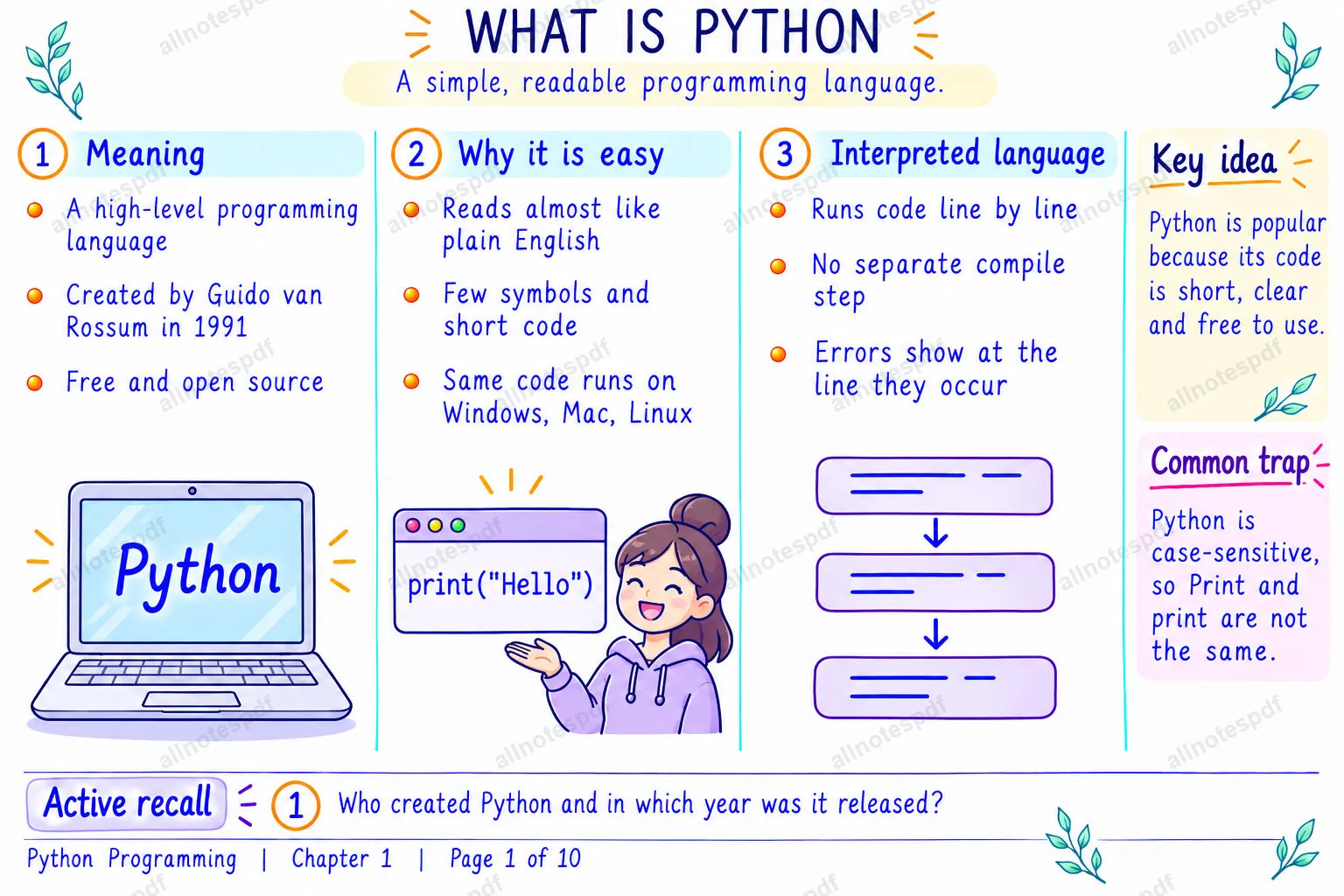
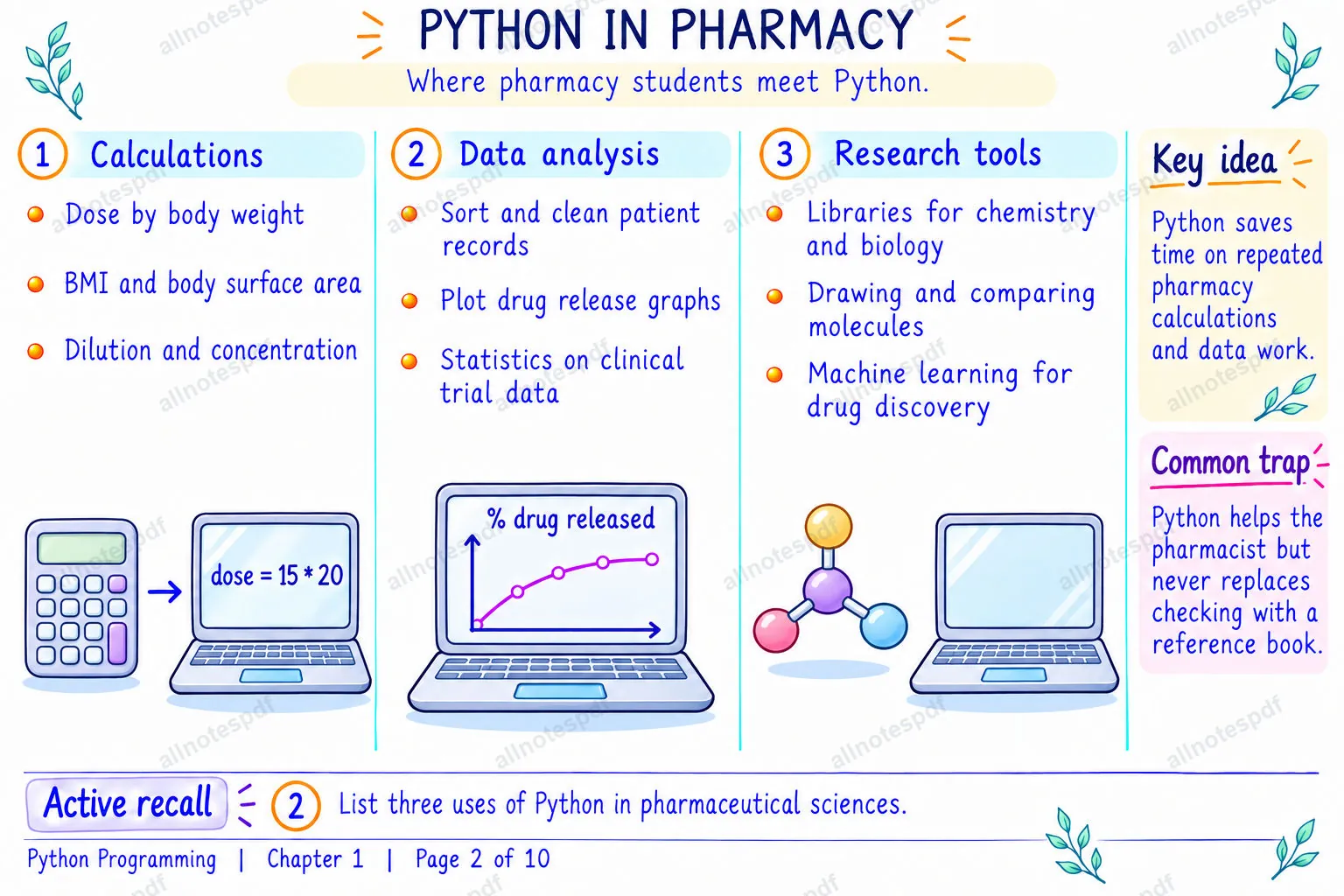
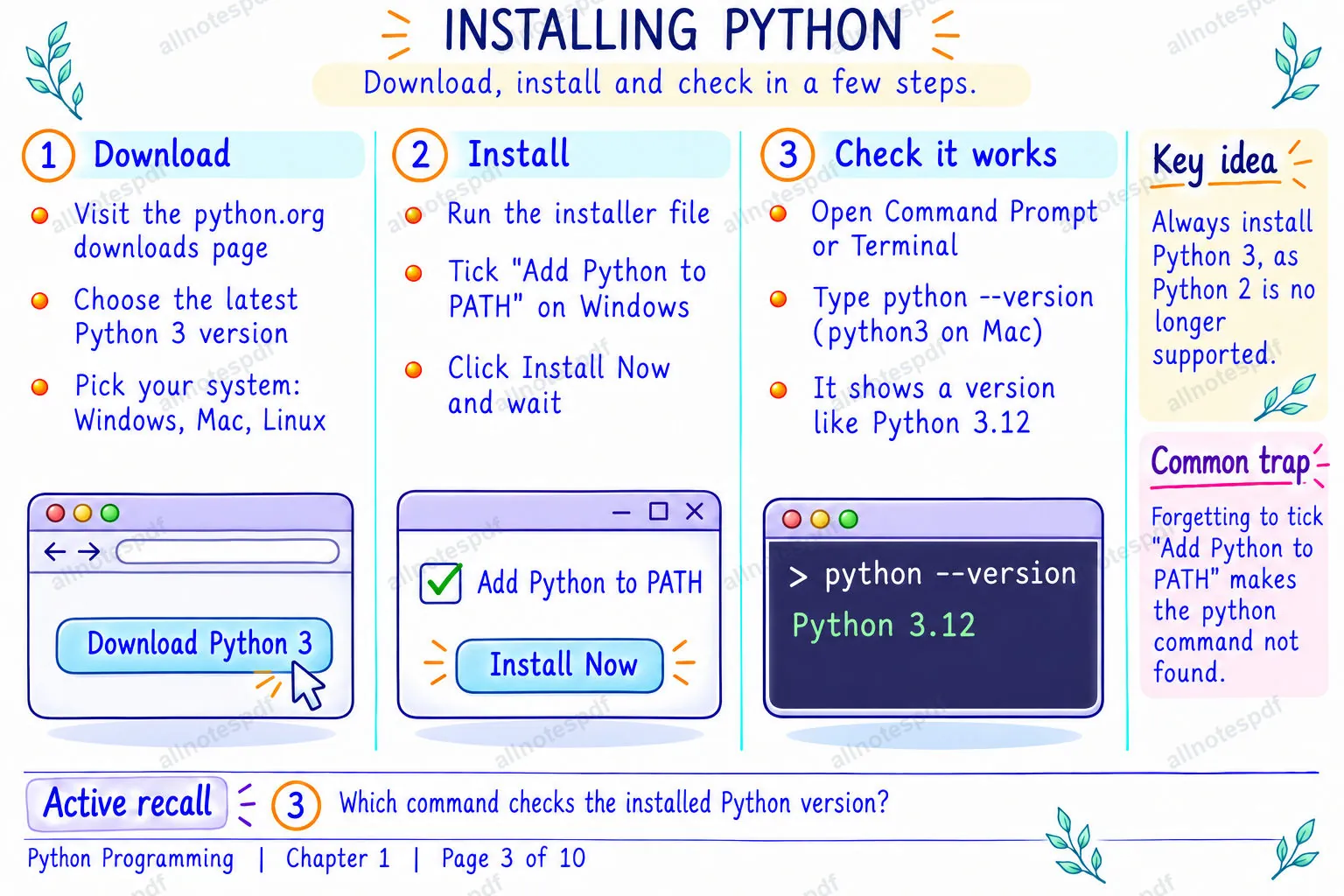
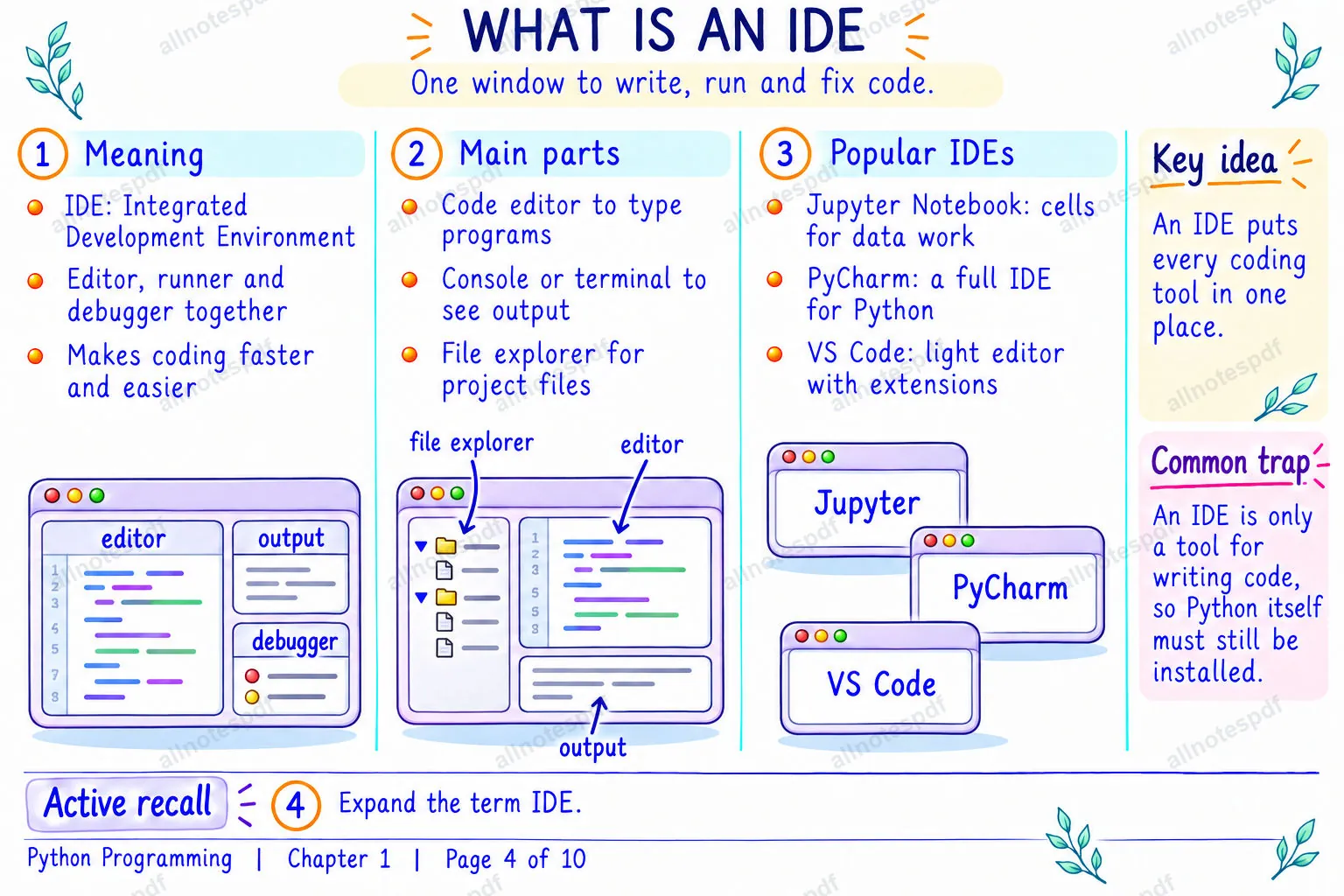
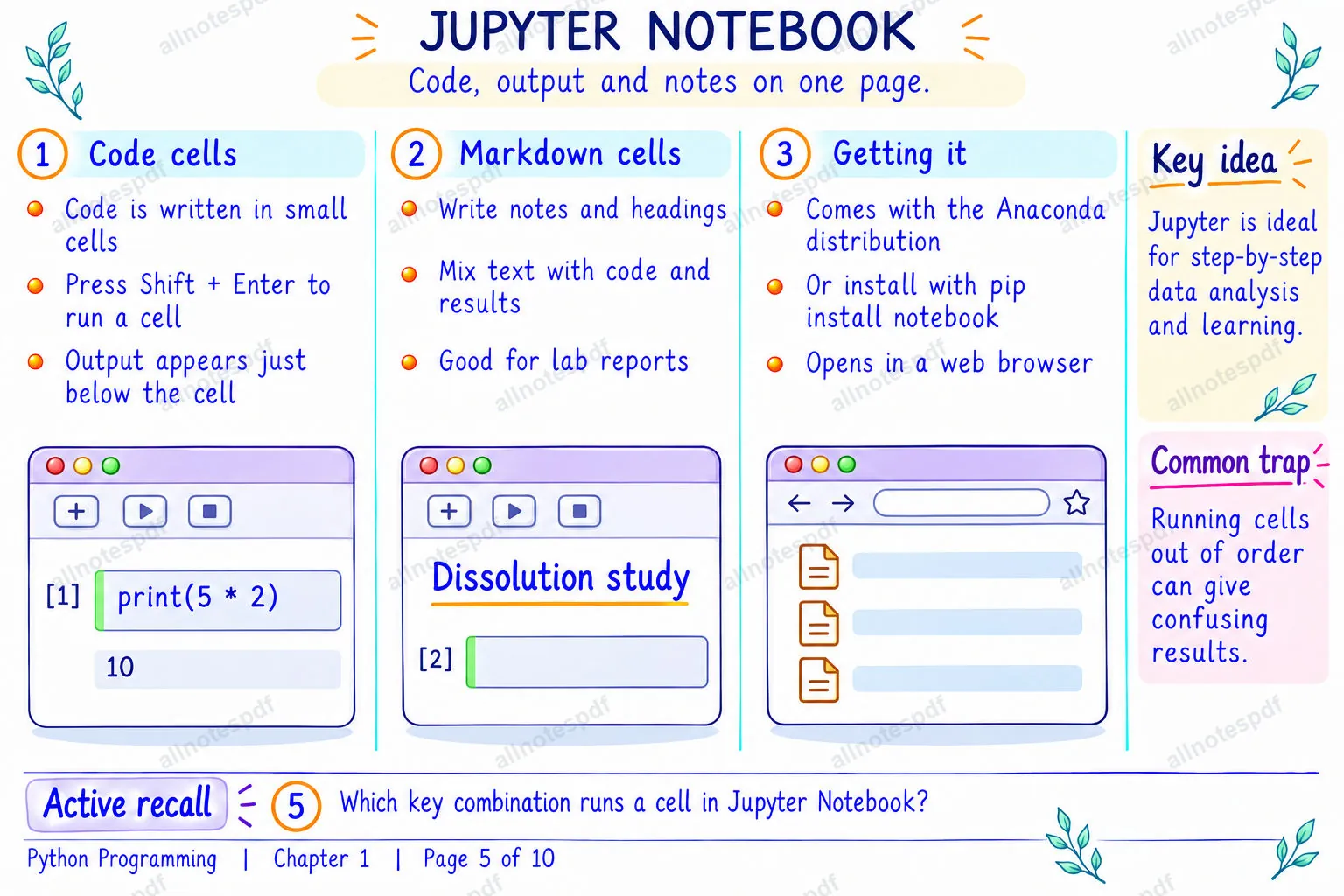
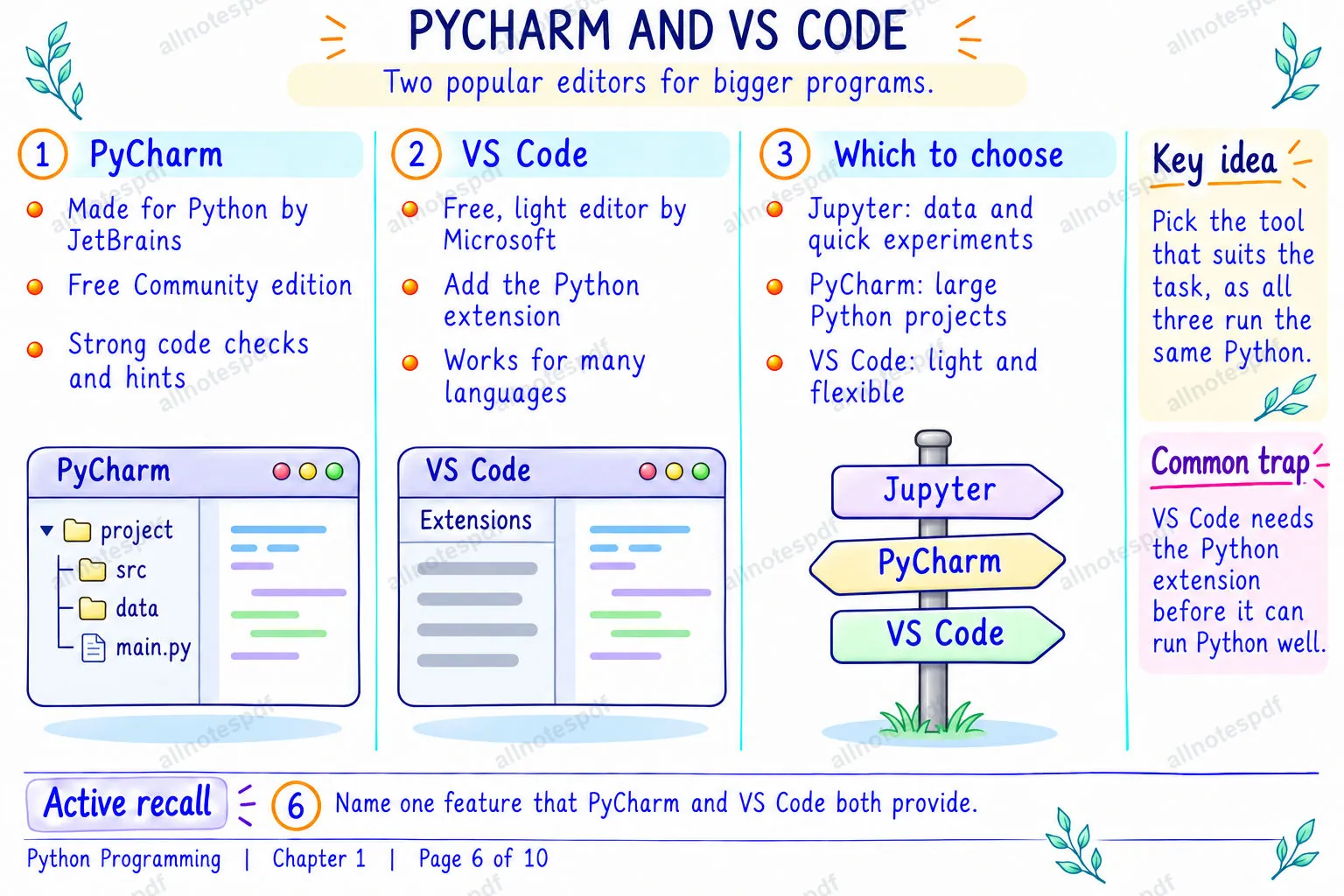
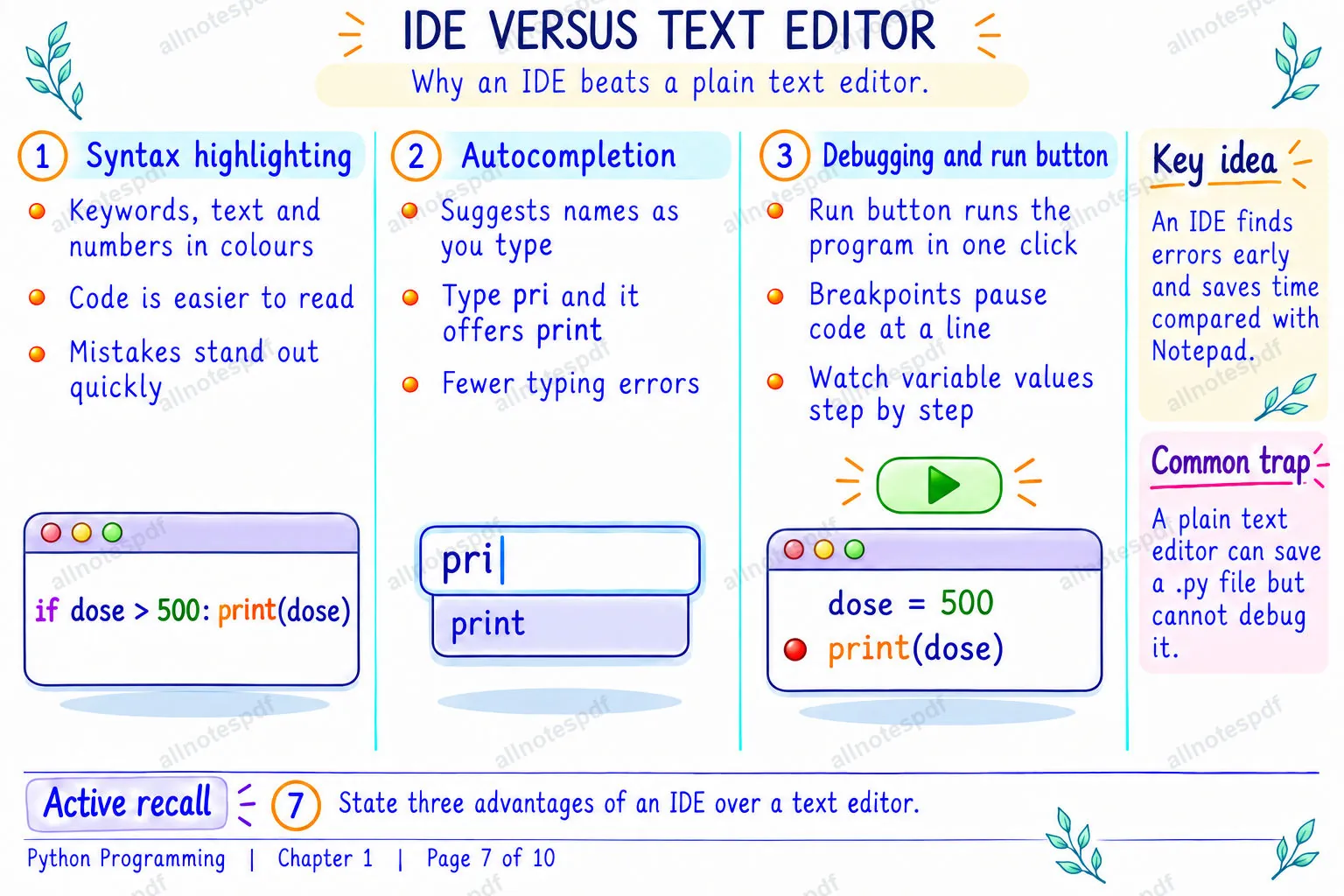
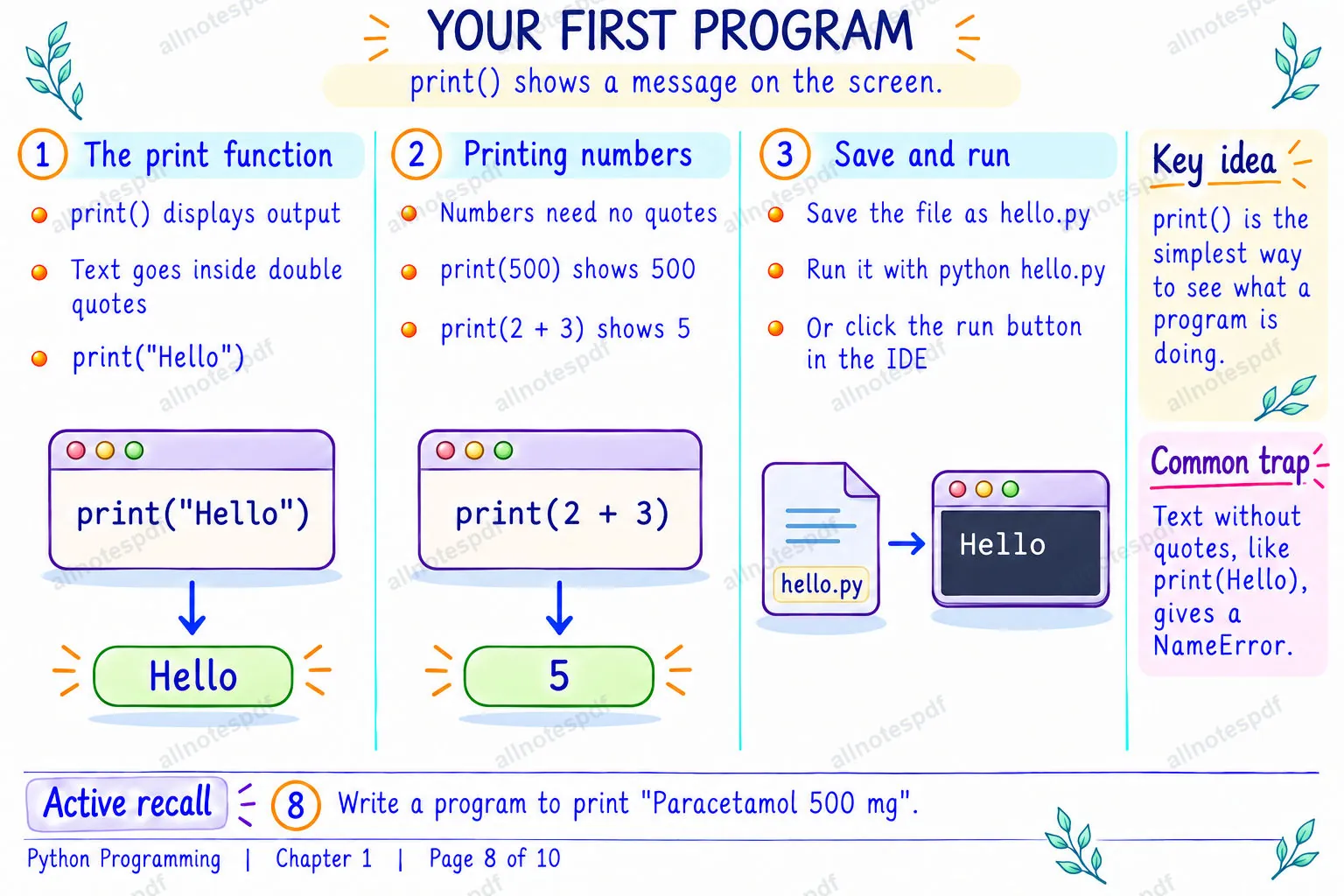
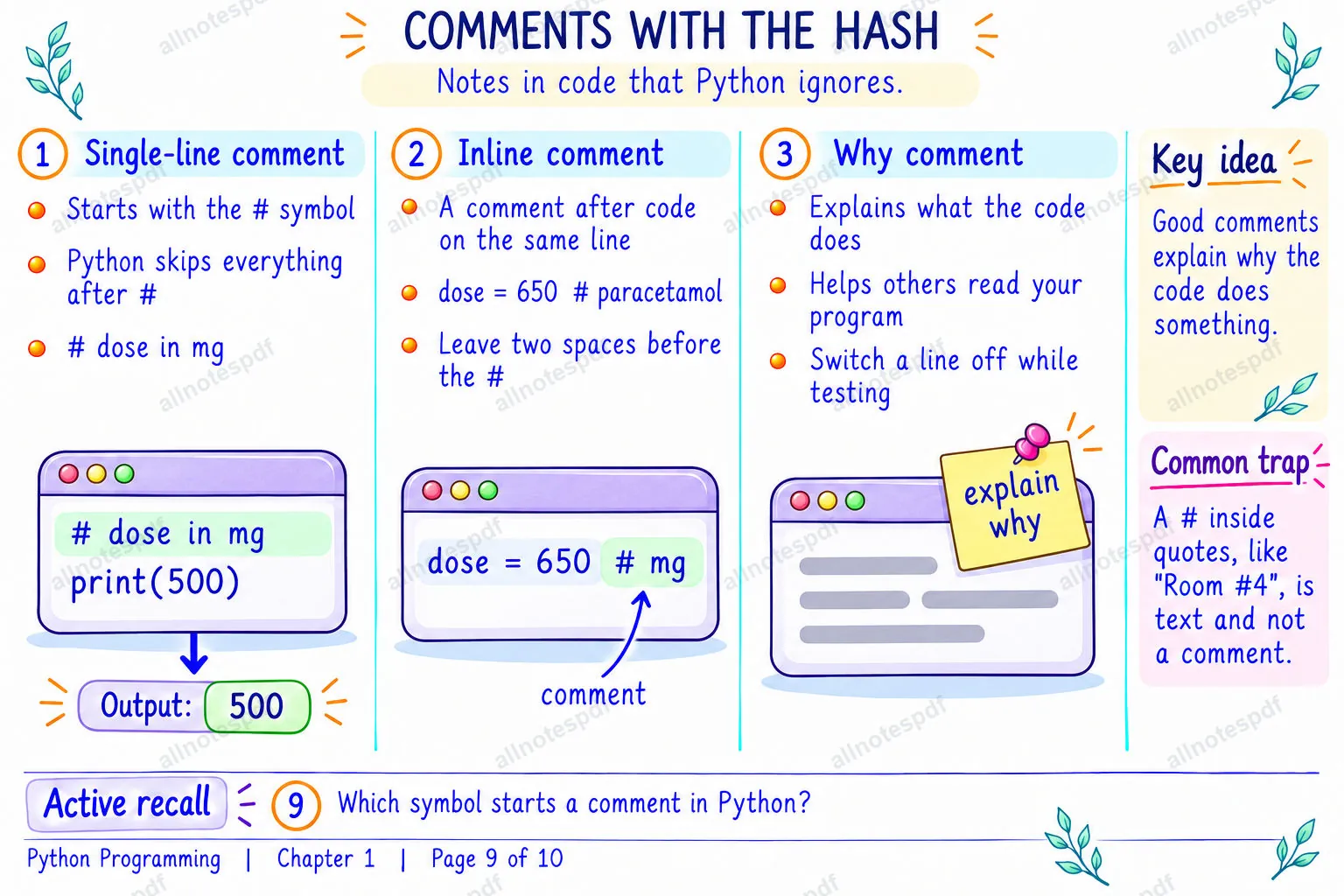
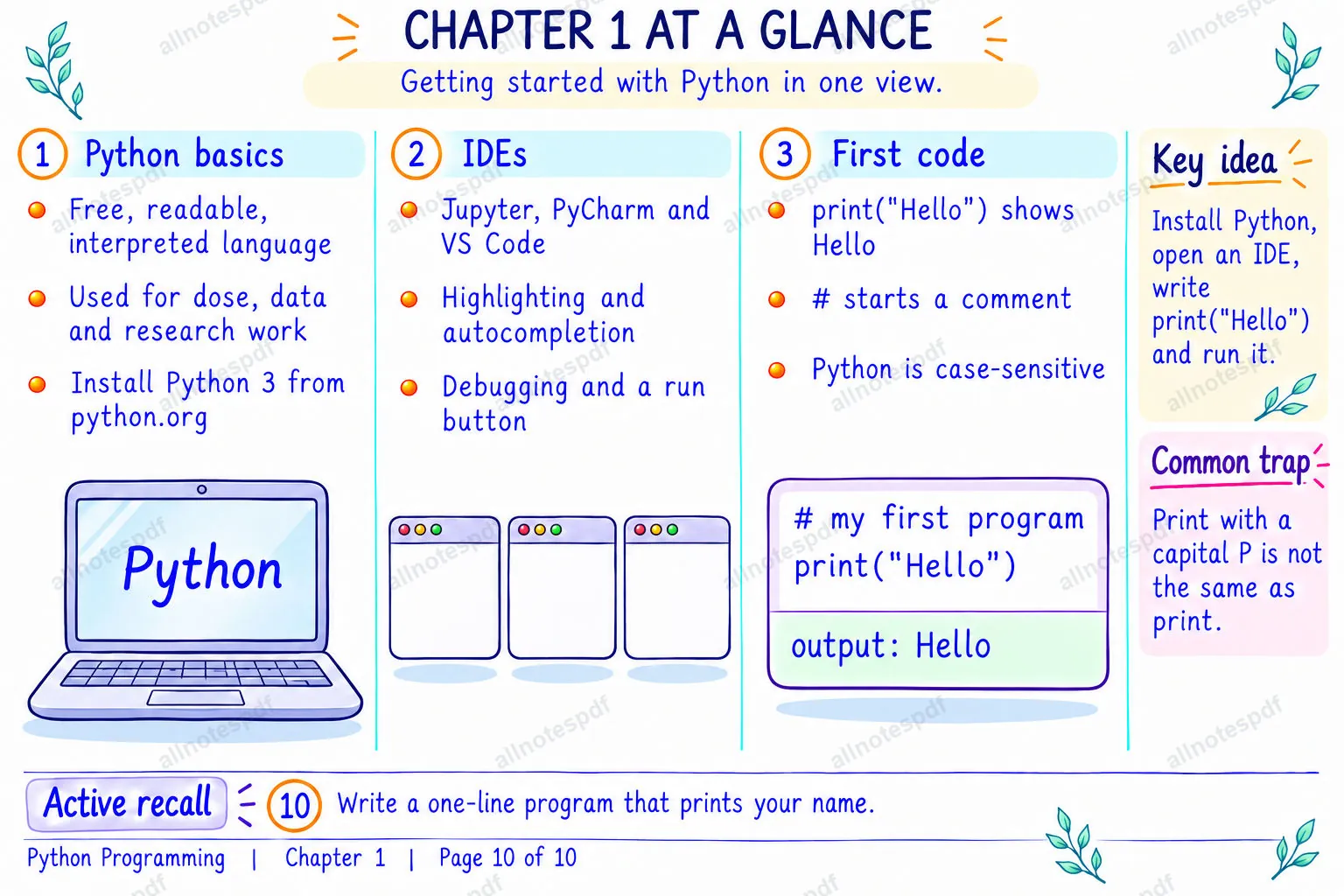
Introduction to Python and its uses in pharmacy, installing Python, IDEs (Jupyter Notebook, PyCharm, VS Code) and their advantages over text editors, the first program with print() and comments.
Covers variables and naming rules, data types (int, float, str, bool), type() and type casting, and arithmetic, comparison and logical operators.
Covers input() and print(), basic string operations (concatenation, repetition, len, upper, lower, strip, replace, indexing, slicing), standard and third-party libraries, import math, and installing and uninstalling with pip.
Covers decision making with if, if-else, if-elif-else and nested conditions, the indentation rule, and pharmacy examples such as maximum dose, BMI category and child or adult dose.
Covers for loop with range(), looping over a list of doses, while loop with a counter, break and continue, and the infinite loop trap.
Covers defining and calling functions, parameters and arguments, return values, default arguments, and modular programs for dose by body weight and BMI with categories.
Covers lists (create, index, slice, append, remove, len, sort), tuples, dictionaries (key and value, access, add, update, keys, values), choosing between them, and string split and join.
Covers numPy arrays, element-wise arithmetic, mean, max and min, reading and writing CSV files with the csv module, structured healthcare datasets, and importing a small pharmaceutical dataset.
Covers the pandas library, Series and DataFrame structures (rows, columns and index), reading CSV and Excel files for PK study data and ADR reports, and inspecting data with head, tail, info, describe and shape.
Covers missing values (NaN), isnull, dropna and fillna, selecting columns, filtering rows by condition, and groupby with count, sum and mean.
Covers matplotlib.pyplot, line plots, histograms, scatter plots, box plots, axis labels, titles, legends, and showing and saving plots.
Covers concentration–time curves for IV bolus and oral doses, Cmax and Tmax, semi-log plots, ADR reporting bar charts and rates, dissolution profiles, and scientific interpretation of plots.
What you get
- Format
- Downloadable PDF (not a printed book)
- Chapters
- 12 chapter PDFs, one per syllabus unit topic
- Syllabus
- B Pharm Semester 1, PCI NEP-2020 syllabus for Basics of Python Programming
- Style
- Handwritten-style notes with colour diagrams, flowcharts and formula boxes
- Devices
- Phone, tablet and laptop. Print any chapter if you like
- Access
- Lifetime. Download again anytime from My library
- Instant downloadRight after payment
- Free updatesCorrections added free
- Secure paymentUPI, cards, net banking