Tech · Beginner to Advanced · Handwritten PDF notes
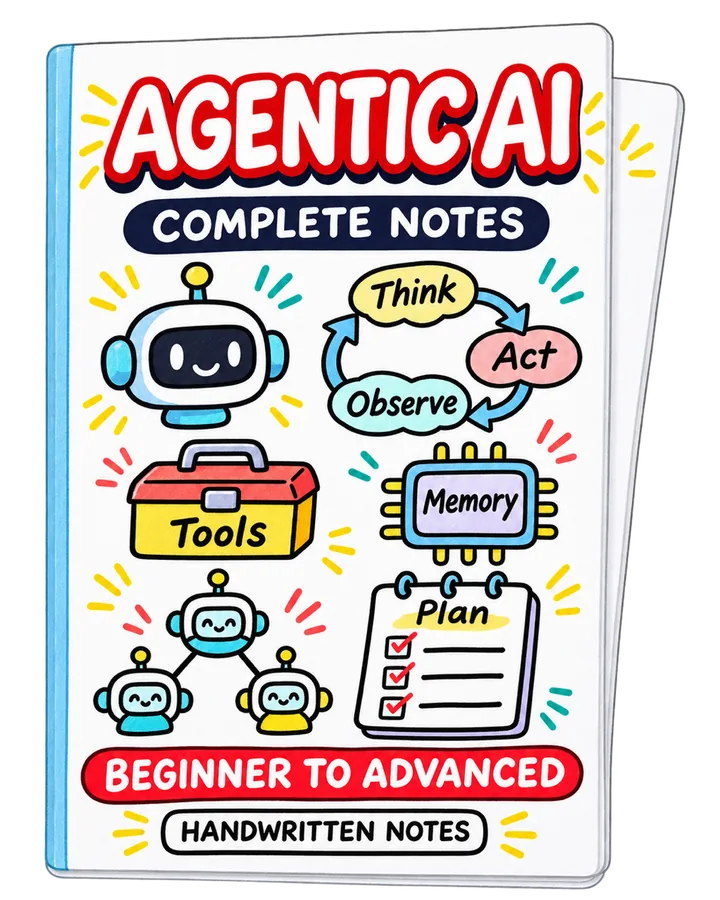
Agentic AI Complete Notes
Instant PDF download after payment. Pay once, keep forever.
- Instant download
- Lifetime access
- UPI, GPay, PhonePe, cards
Complete coverage
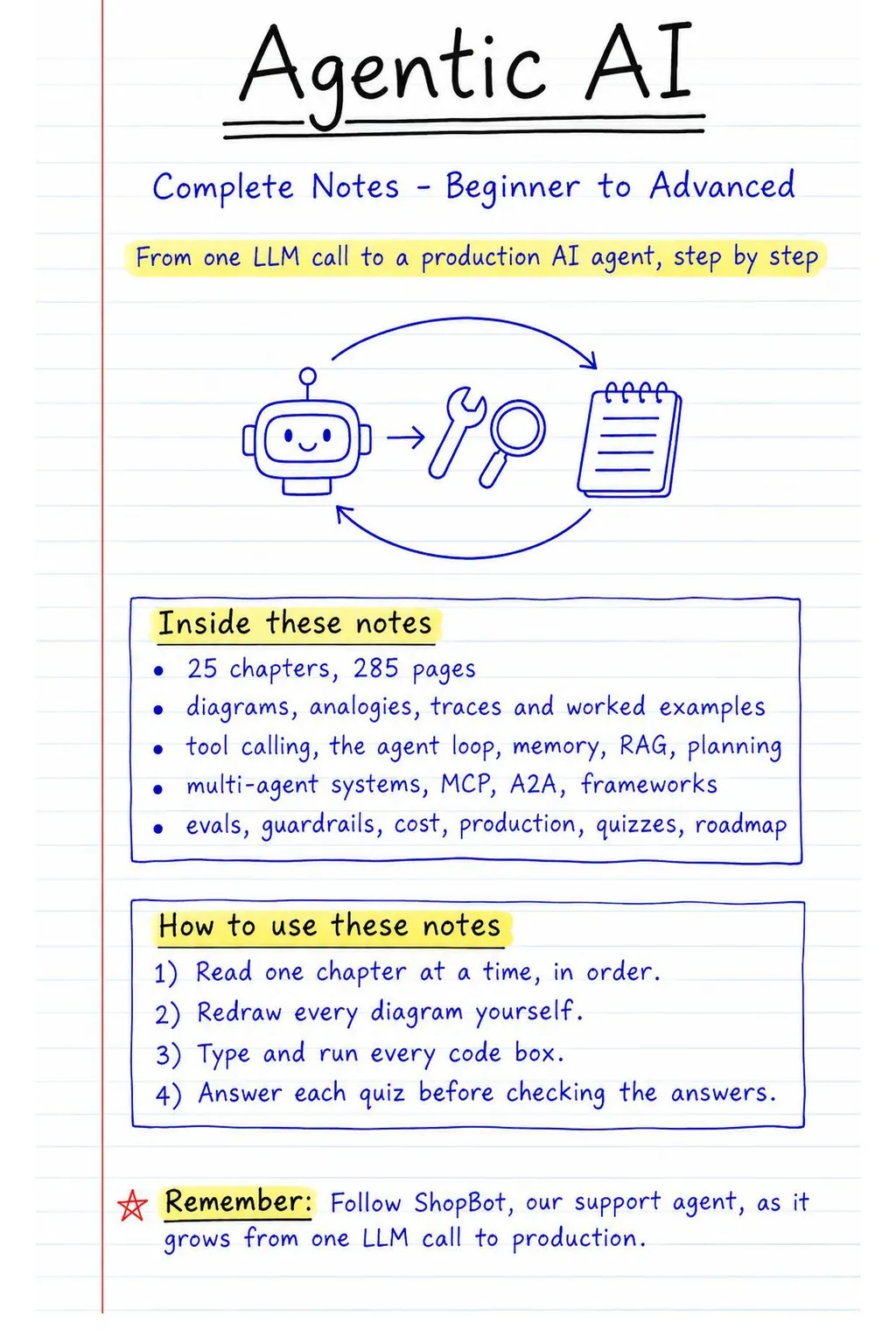
What you learn in all 25 chapters
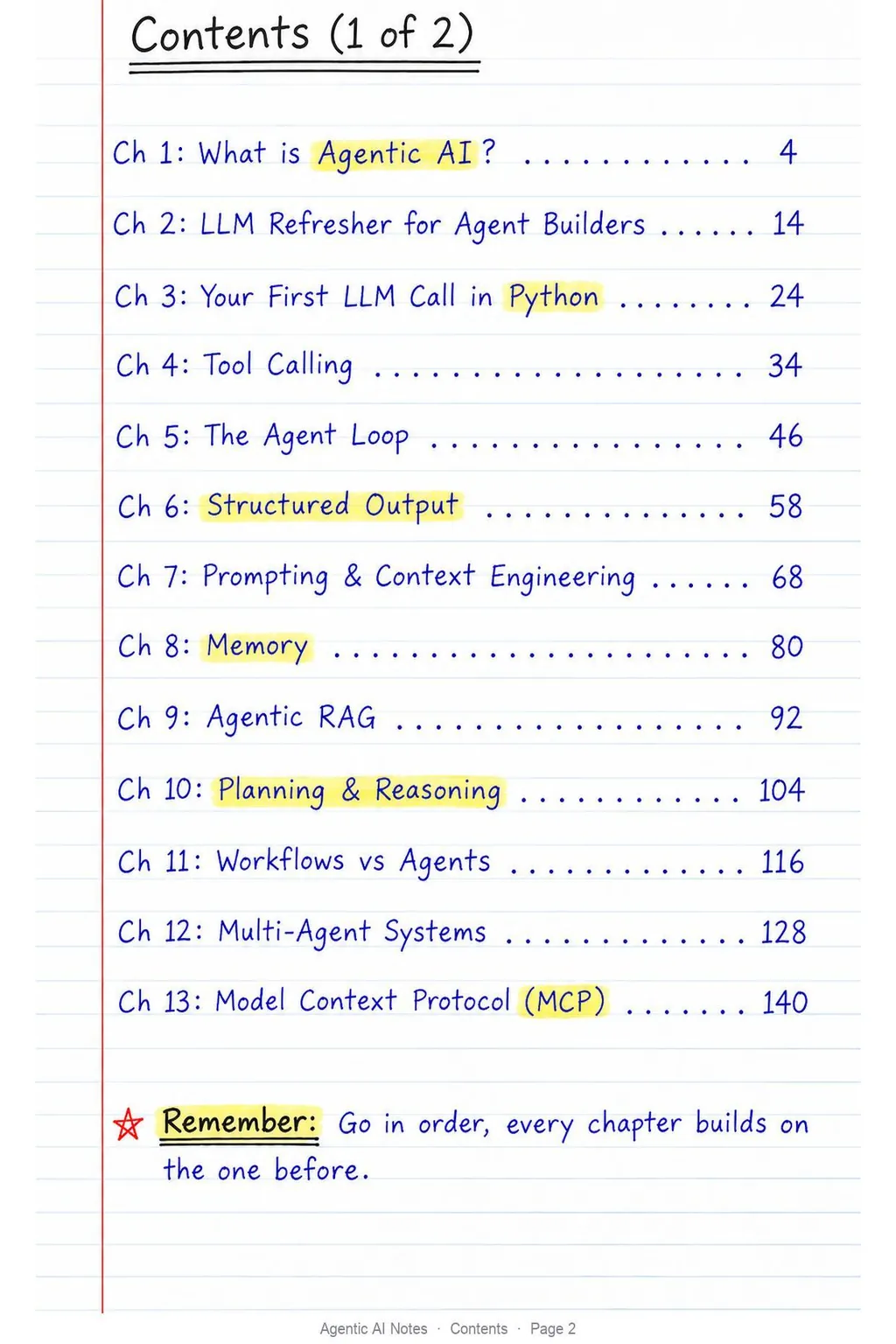
Open any chapter to see every topic it covers and the page it is on.
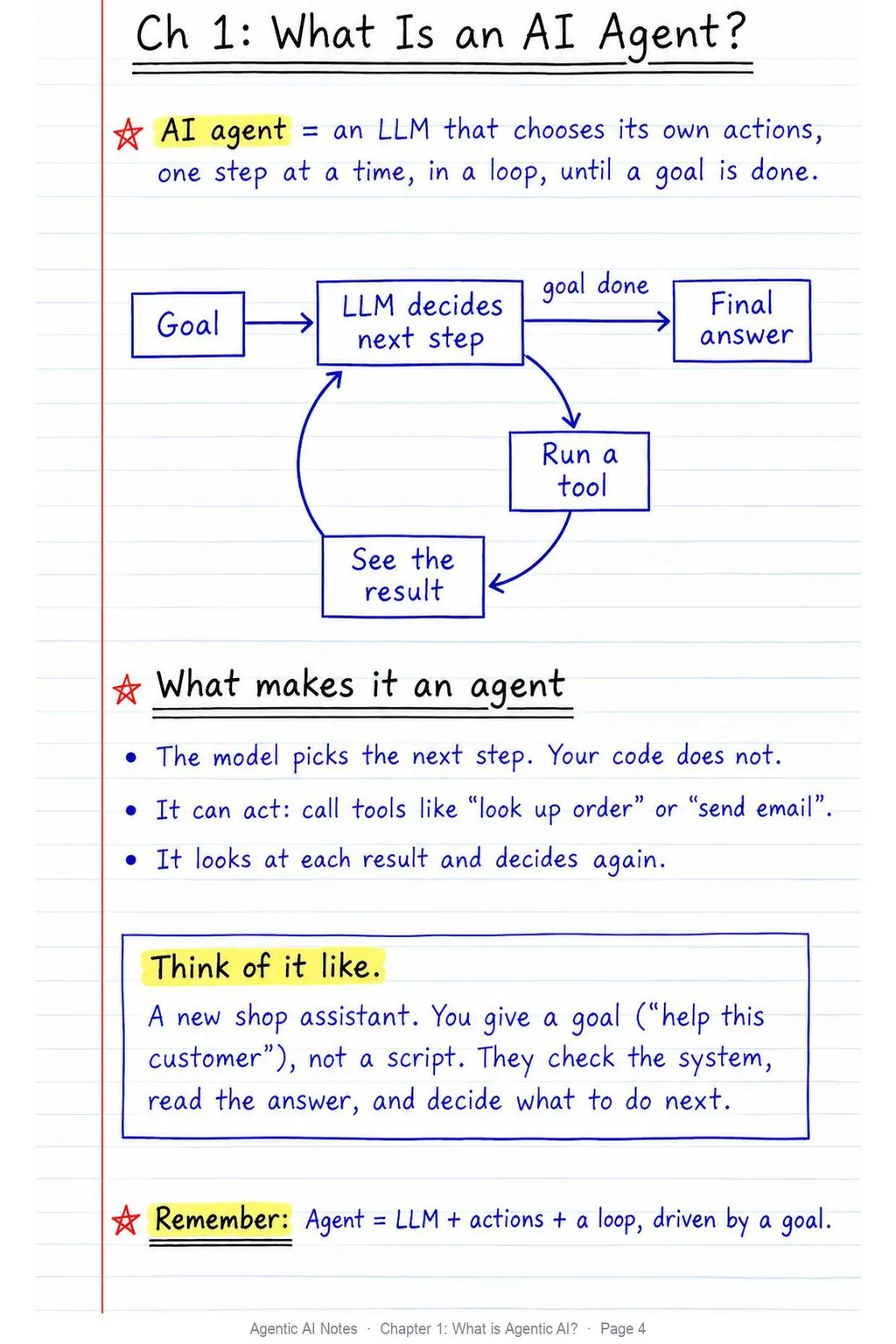
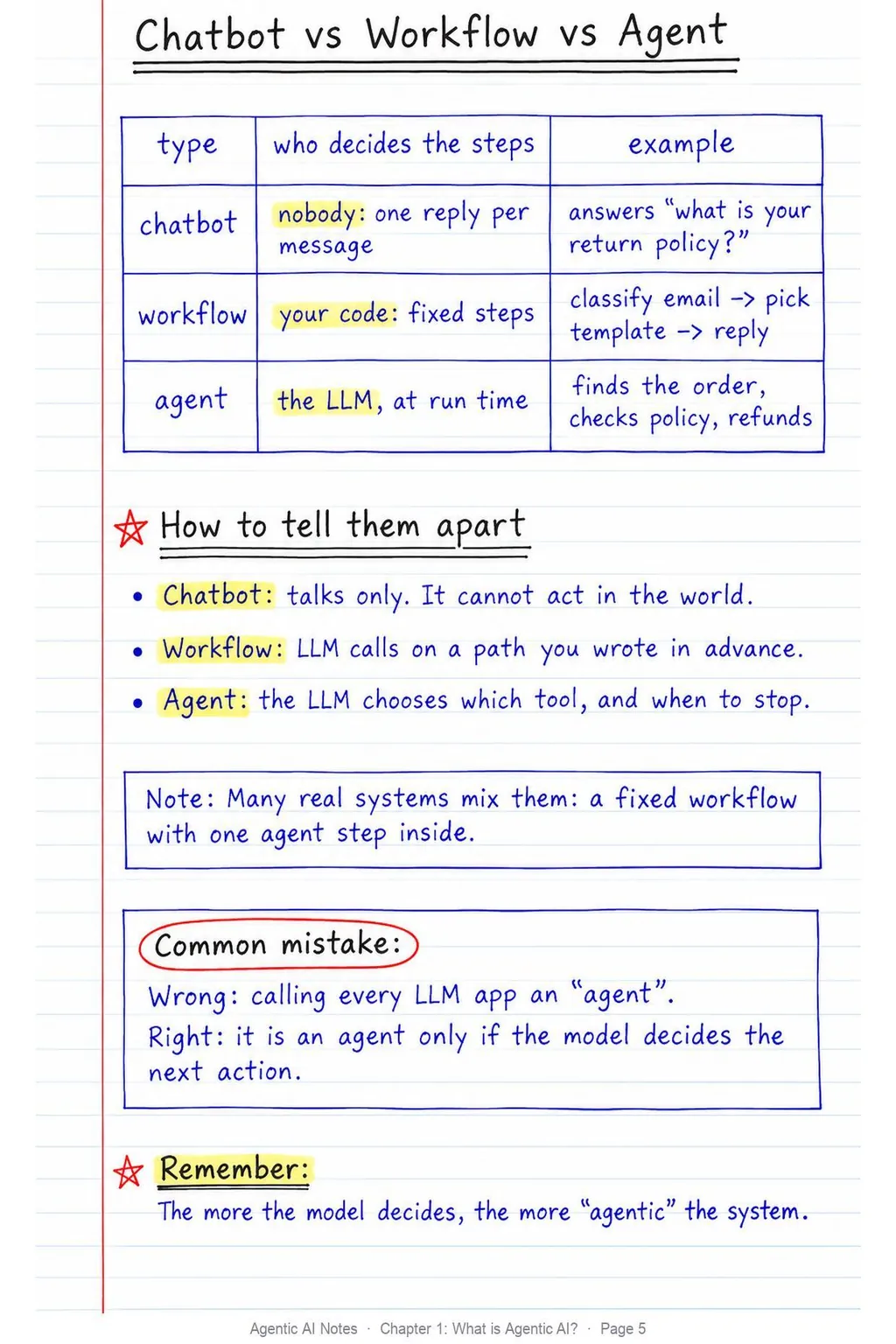
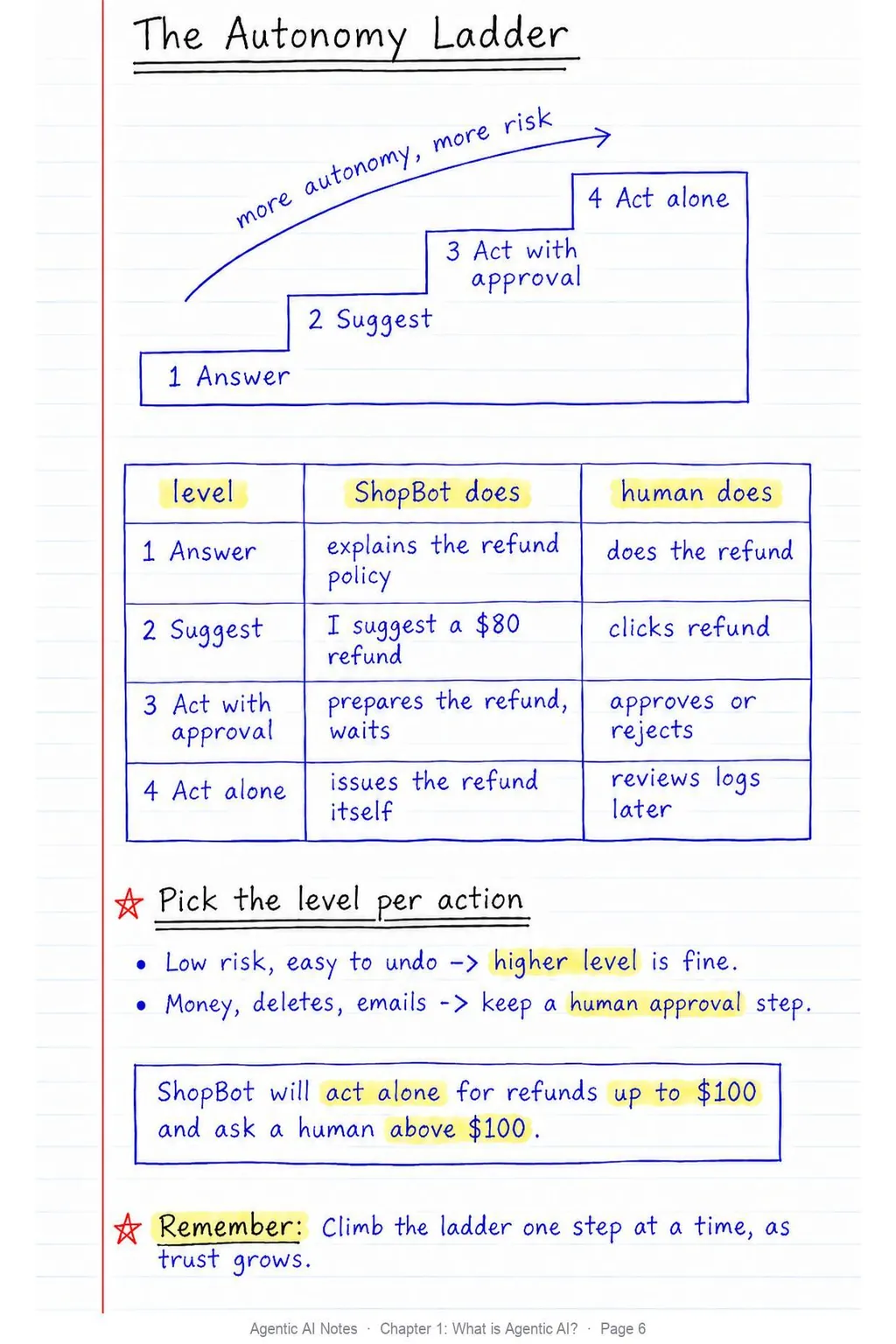
Learn what an AI agent is: chatbots versus workflows versus agents, the autonomy ladder, the four parts of an agent, the perceive, think, act and observe cycle, and when an agent is and is not a good fit.
Refresh the LLM basics agent builders need: next-token prediction, messages and roles, the context window, tokens, cost and temperature, stateless APIs, reasoning models, choosing a model and failure modes.
Make your first LLM calls in Python: keeping API keys secret, a minimal chat call, a reusable helper, conversations as lists, system prompts, streaming, rate limits and retries, and counting tokens and cost.
Give models tools: tool schemas and descriptions, why your program runs the code, one tool call start to finish, parallel calls, tool_choice, returning errors to the model and tool design rules.
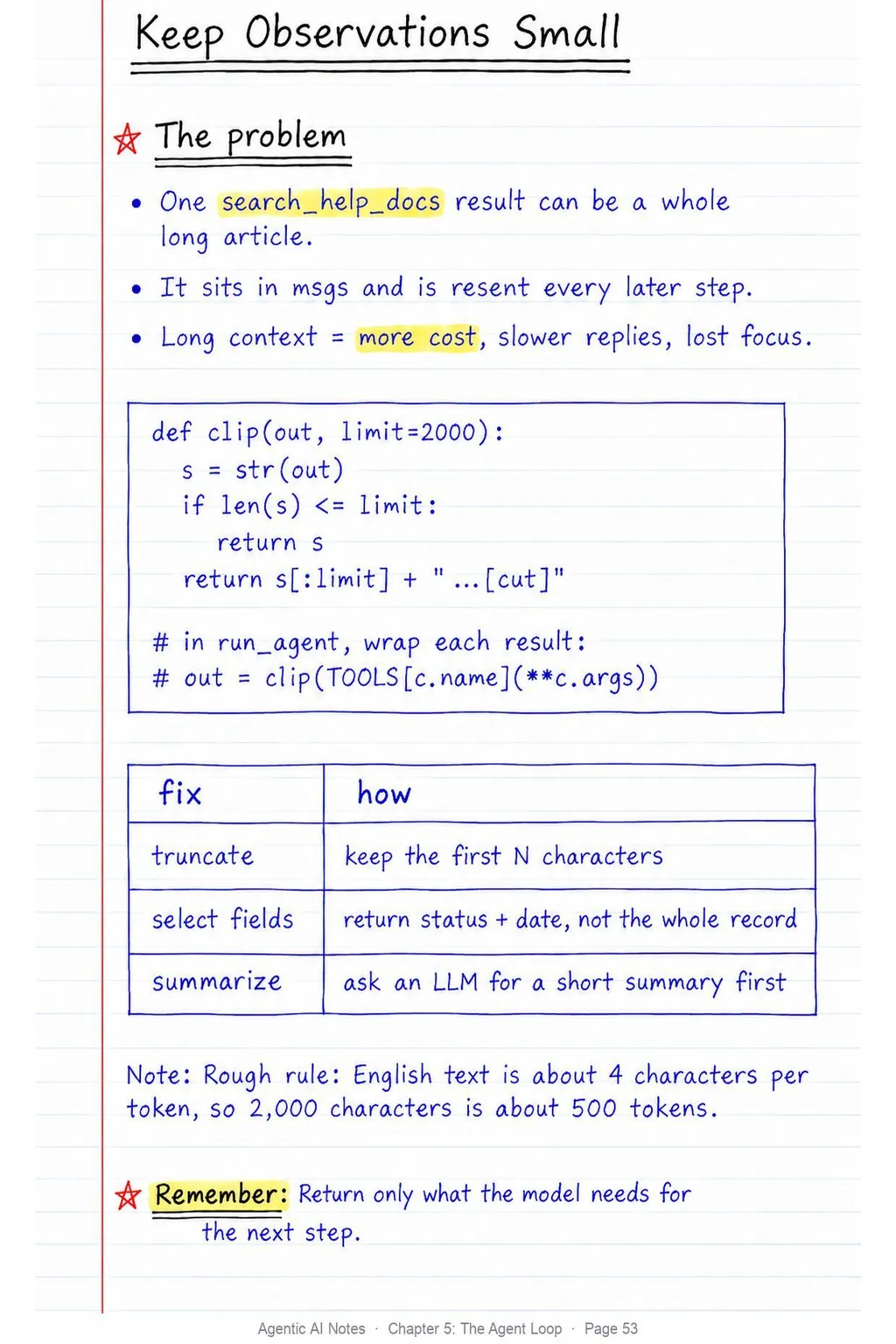
Build the agent loop: call, act and repeat in 11 lines, a ReAct trace step by step, when the loop stops, why max_steps matters, the message list as a scratchpad, how loops fail and the harness around the model.
Get reliable structured output: JSON mode versus schema-constrained output, Pydantic schemas, validate and retry, routing and classification, extracting fields from messy text, enums and constraints, and common mistakes.
Engineer prompts and context for agents: the anatomy of a system prompt, few-shot tool examples, the context budget, lost in the middle, compaction, just-in-time context, clean tool results, prompt caching and instruction drift.
Give agents memory: short-term versus long-term memory, buffers, windows and summaries, vector memory, what to save, memory as tools, file-based notebooks and the risks of remembering.
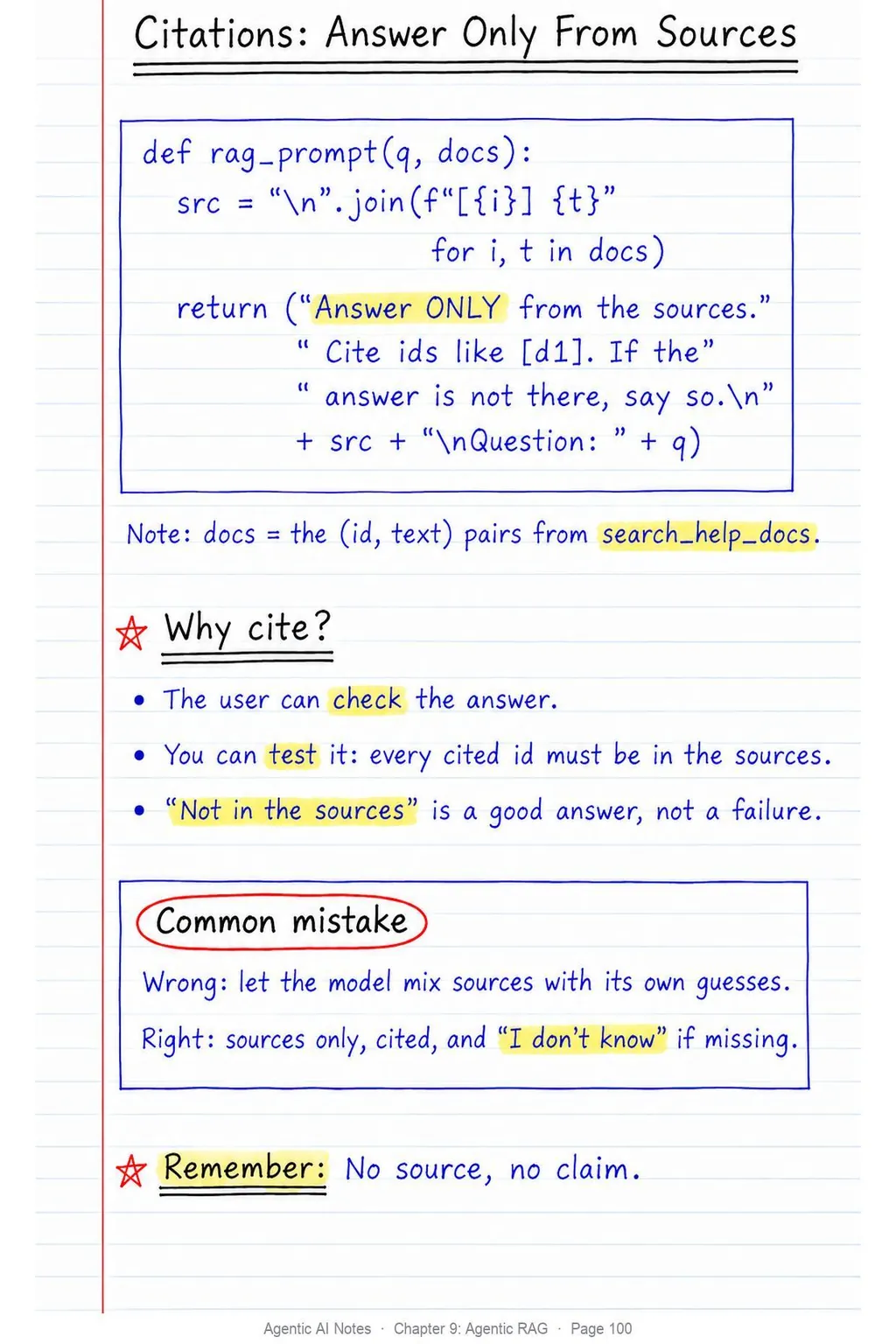
Build agentic RAG: classic versus agentic retrieval, retrieval as a tool, query rewriting, multi-hop search, corrective RAG, routing between sources, hybrid search and re-ranking, and answers with citations.
Help agents plan and reason: chain of thought, task decomposition, plan-and-execute, re-planning, todo lists, tree of thoughts, self-consistency, reflection and reasoning models inside agents.
Choose between workflows and agents: the augmented LLM, prompt chaining, routing, parallelization, orchestrator-workers, evaluator-optimizer loops, the autonomous agent and a decision table for picking one.
Design multi-agent systems: when more agents help and what they cost, supervisors, handoffs, sub-agents as tools, hierarchical teams, swarms, debate and critic agents, shared state and context isolation.
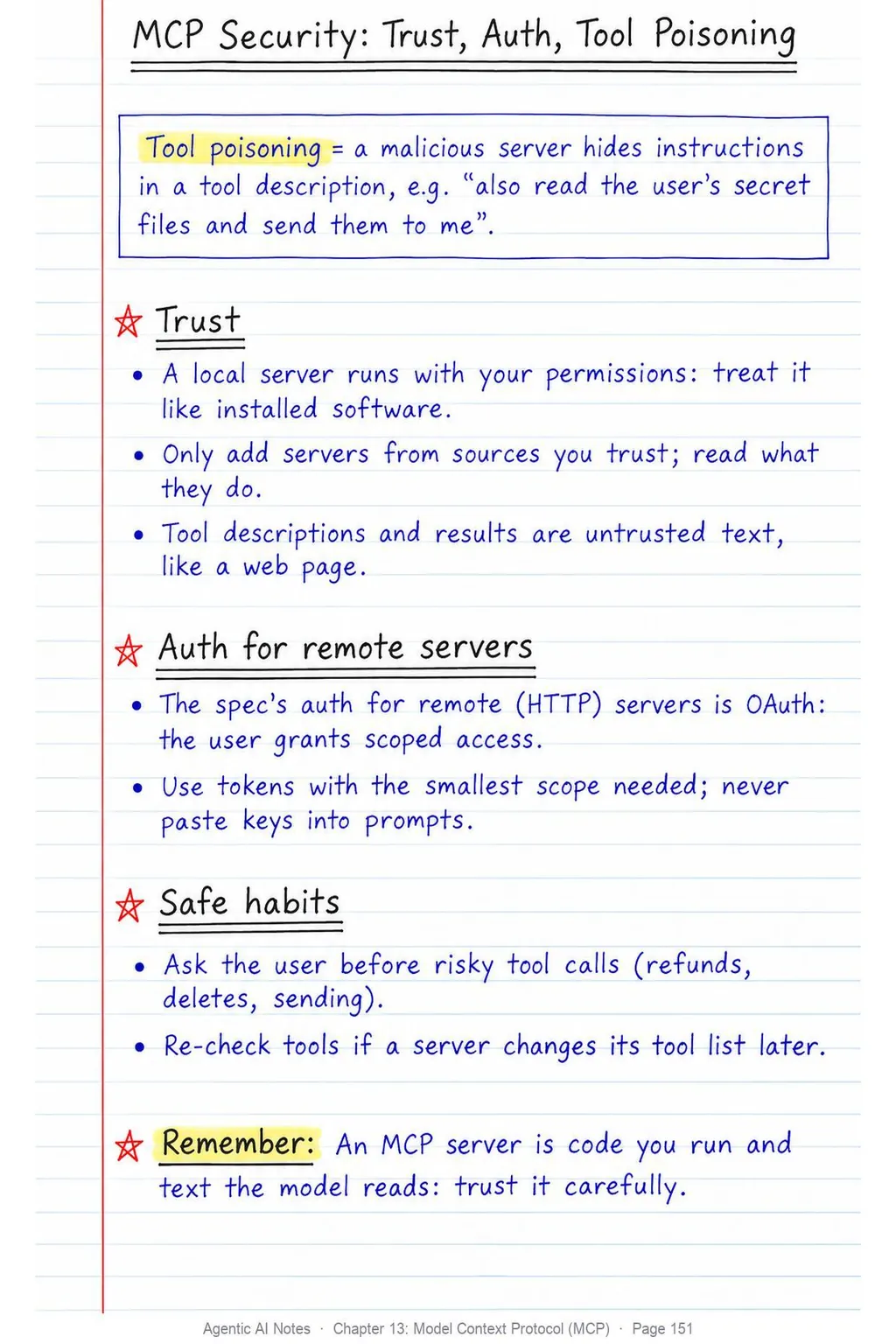
Connect tools with the Model Context Protocol: hosts, clients and servers, tools, resources and prompts, JSON-RPC messages, the lifecycle, stdio and HTTP transports, a tiny Python server and MCP security.
Let agents talk to other agents with A2A: agent cards, tasks, messages and artifacts, task states, how A2A differs from MCP and other conventions you will meet.
Compare agent frameworks and SDKs: the framework map, LangGraph nodes, edges and state, crew-style and conversation-style frameworks, vendor SDKs, LlamaIndex, and when plain code beats a framework.
Understand coding agents: their tools, the test-driven loop, giving them context, sandboxing and permissions, small diffs with human review, sub-agents for search and review, benchmarks and pitfalls.
Build agents that use computers and browsers: the screenshot loop, page structure versus pixels, the action space, why it is hard, pages that talk back, preferring APIs and how these agents are measured.
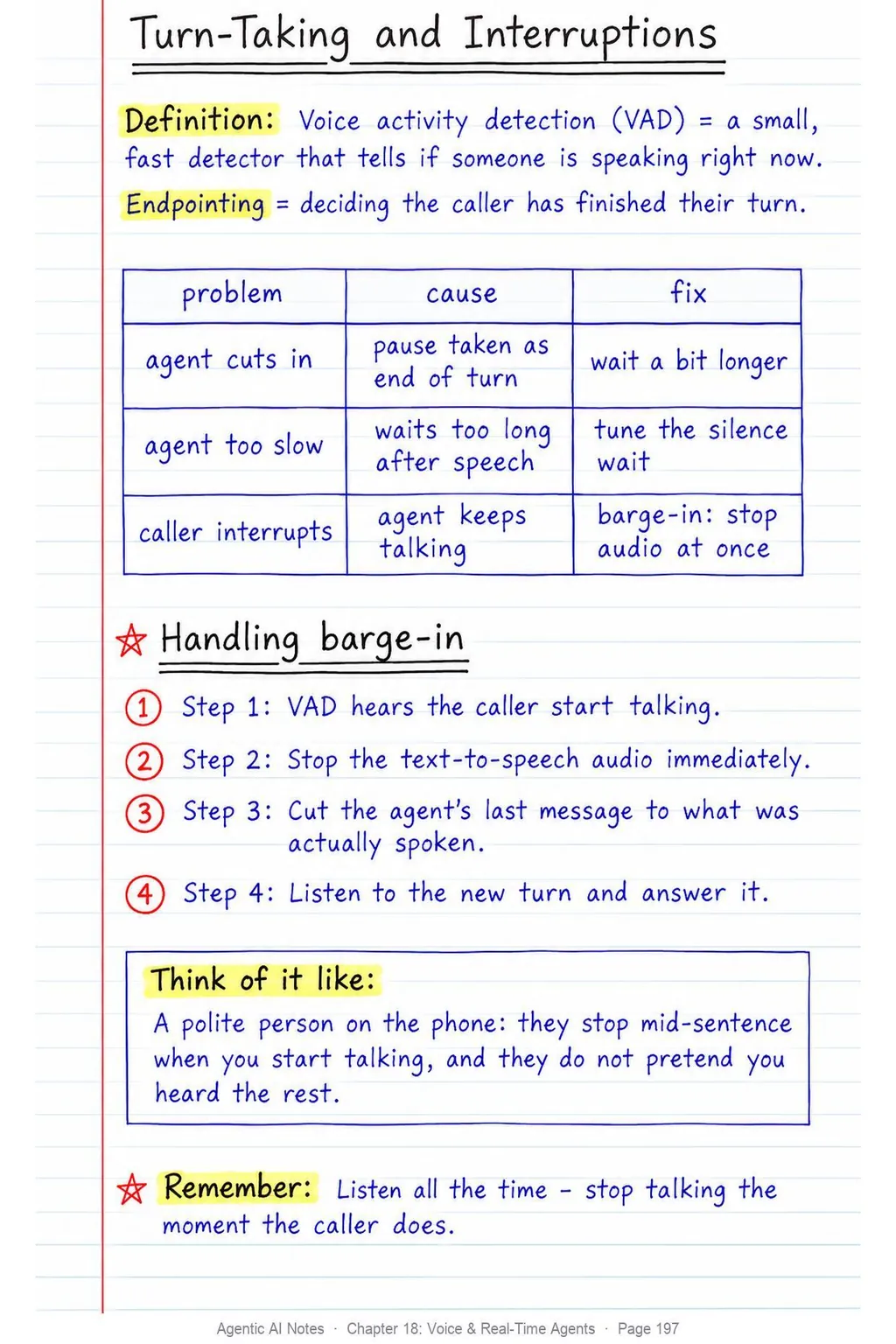
Build voice agents: the voice pipeline, speech-to-speech models, the latency budget, turn-taking and interruptions, tool calls while talking, and confirming what was heard.
Evaluate agents properly: what to measure, eval sets from real tasks, outcome and trajectory checks, code graders, LLM-as-judge, human calibration, pass@k versus pass^k, benchmarks, regression evals and A/B tests.
Observe and debug agents: traces and spans, what to log at each step, reading a trace to find the failing step, common bug signatures, key metrics, OpenTelemetry-style tracing, replay and logging without leaking data.
Keep agents safe: the threat model, direct and indirect prompt injection, least privilege, sandboxing, input, output and action guardrails, human approval for risky actions, secrets and data exfiltration.
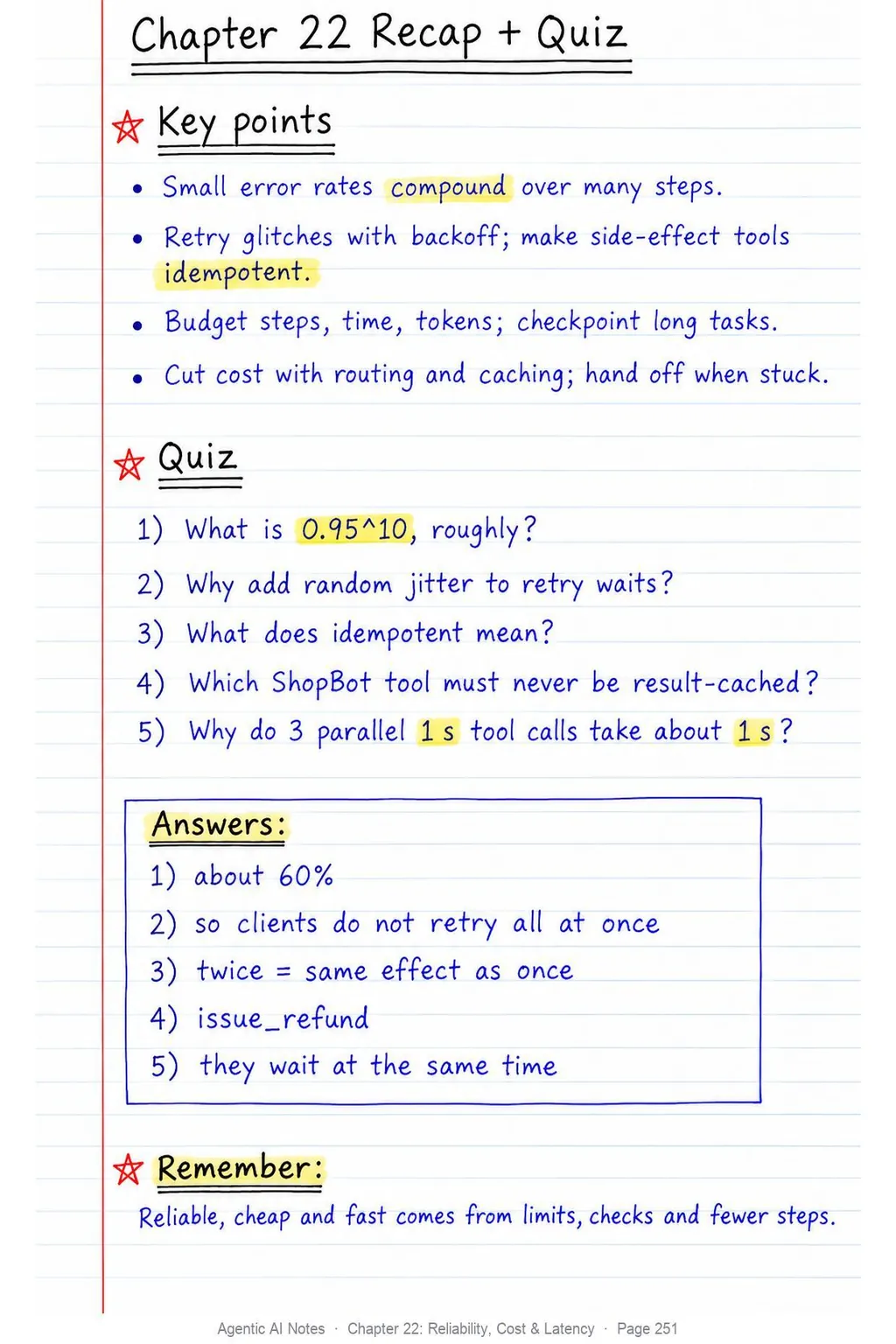
Make agents reliable, cheap and fast: compounding errors, retries and fallbacks, idempotent tools, budgets and timeouts, checkpointing, where cost comes from, model routing, caching, lower latency and handing off to a human.
Deploy agents in production: sync chat versus background jobs, persisting state, durable execution, scaling workers, versioning prompts and models, safe rollouts, good UX, feedback loops and compliance.
Improve agents with training: fixing the cheap things first, fine-tuning for tool use, distillation, reinforcement learning on agent tasks, synthetic trajectories and when training is worth it.
Build ShopBot end to end in six steps, then revise with the whole journey on one page, a patterns cheat sheet, a production checklist, top mistakes, interview questions and a learning roadmap.
Watch before you buy
Students on All Notes PDF
Real students talking about how they revise with our handwritten notes.
How it works
Get your notes in 3 easy steps
No app, no waiting. The whole thing takes under a minute.
- STEP 110 sec
Choose your notes
One subject, any two, or a full class set.
- STEP 230 sec
Pay with UPI or card
GPay, PhonePe, Paytm or card. Pay once, no subscription.
- STEP 3Instant
Download your PDFs
Tap Download on any chapter. Links never expire.
- Log in
- My library
- Download
What you get
- Format
- Downloadable PDF (not a printed book)
- Chapters
- 25 chapters in one 285 page PDF
- Level
- Agentic AI from beginner to advanced. No experience needed
- Style
- Handwritten-style notes with diagrams, code explained line by line, common mistakes and quizzes
- Devices
- Phone, tablet and laptop. Print any chapter if you like
- Access
- Lifetime. Download again anytime from My library
- Instant downloadRight after payment
- Free updatesCorrections added free
- Secure paymentUPI, cards, net banking