Tech · Beginner to Advanced · Handwritten PDF notes
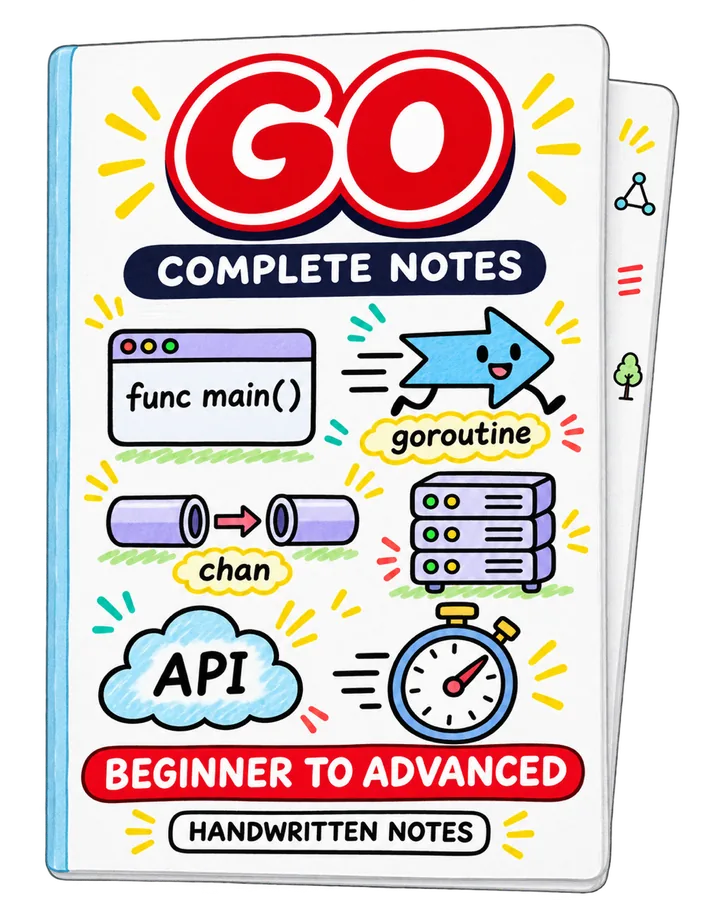
Go Complete Notes
Instant PDF download after payment. Pay once, keep forever.
- Instant download
- Lifetime access
- UPI, GPay, PhonePe, cards
Complete coverage
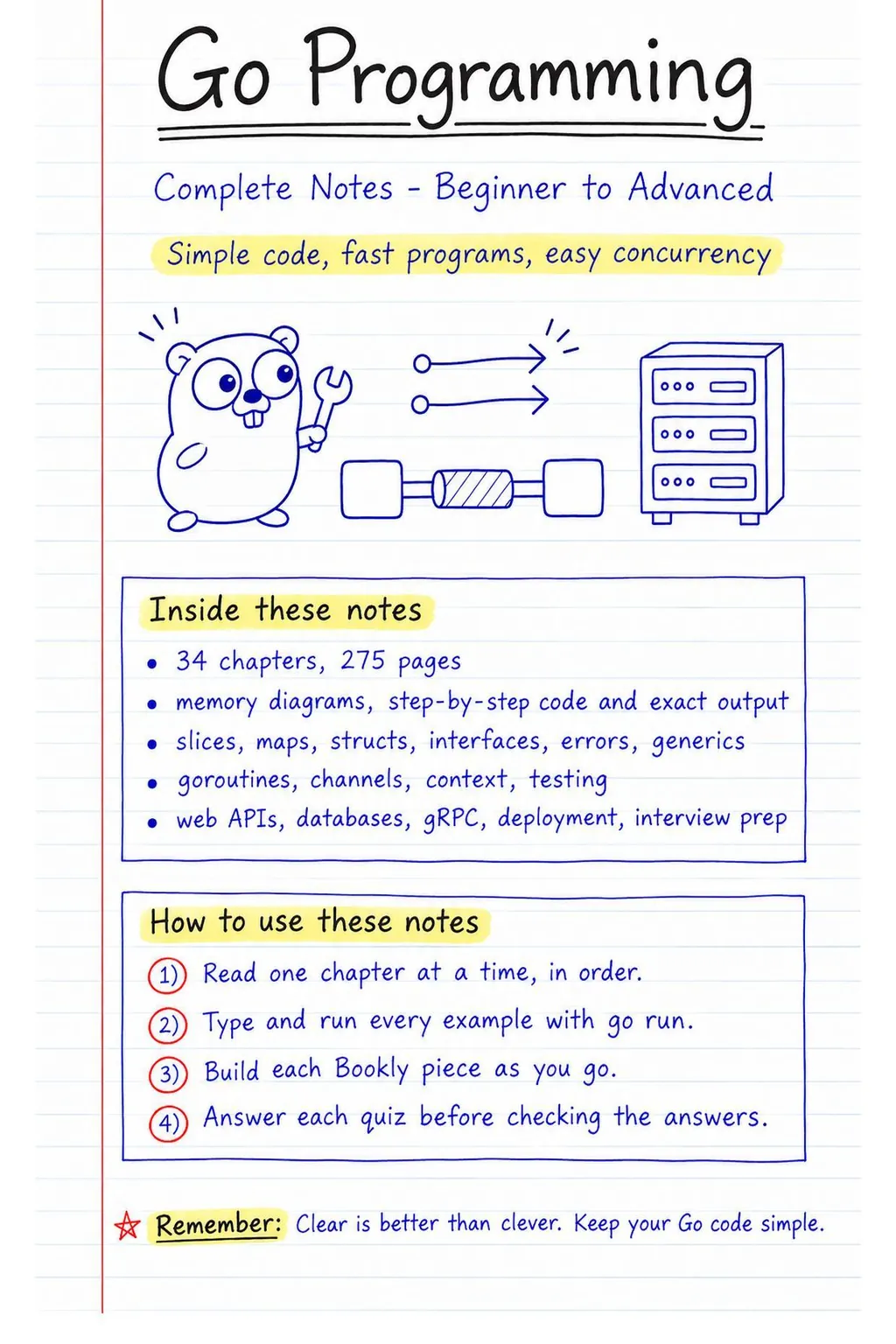
What you learn in all 34 chapters
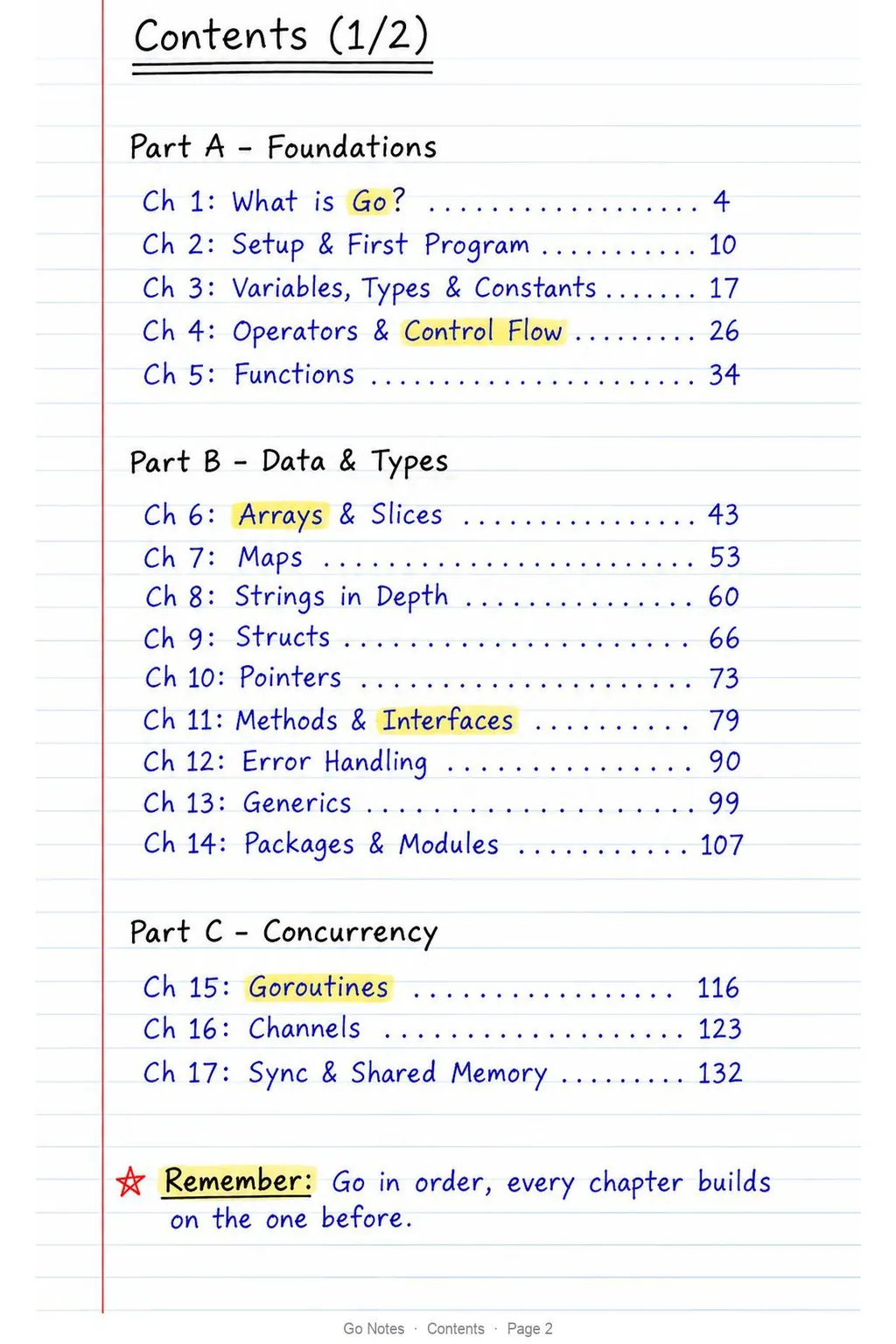
Open any chapter to see every topic it covers and the page it is on.
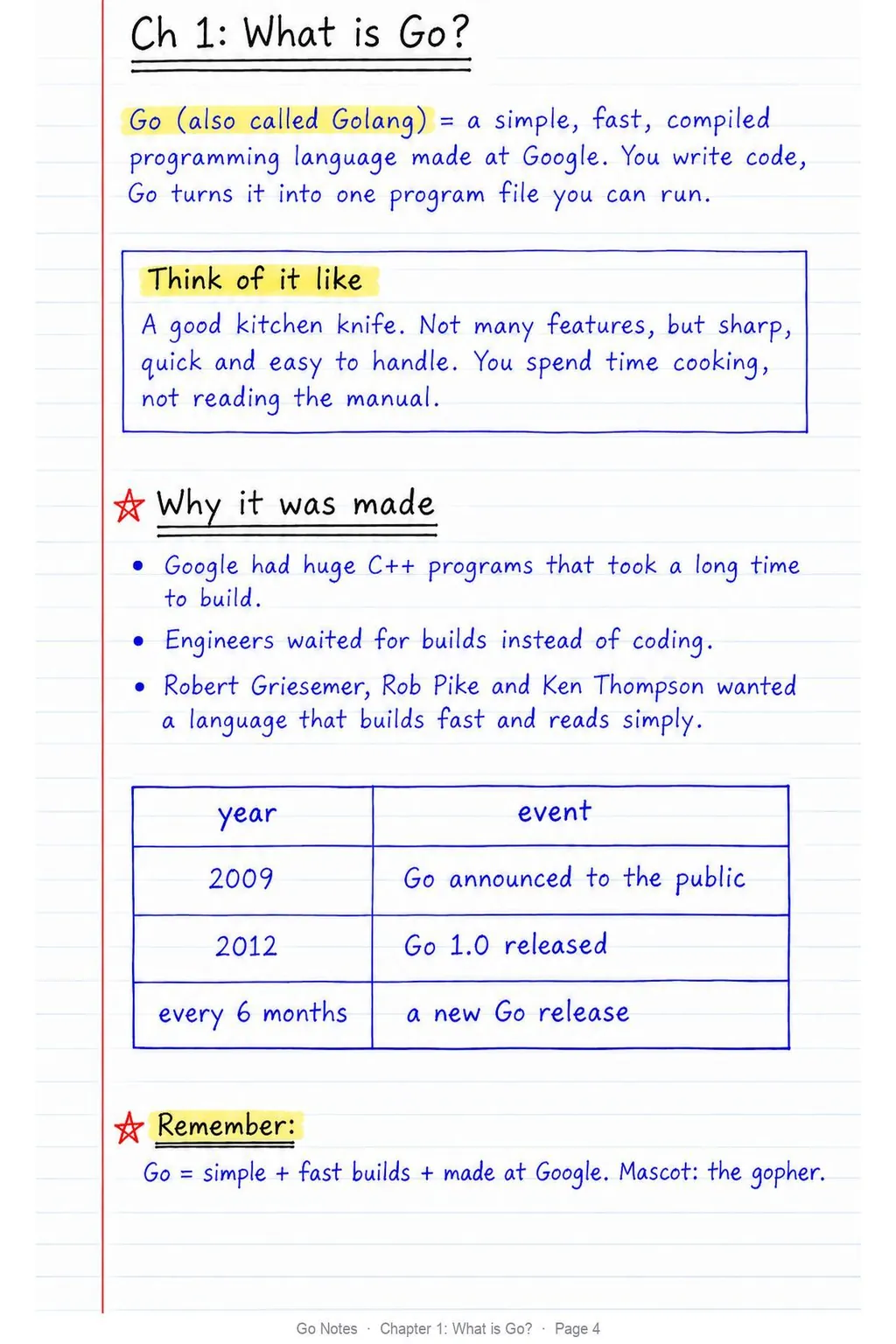
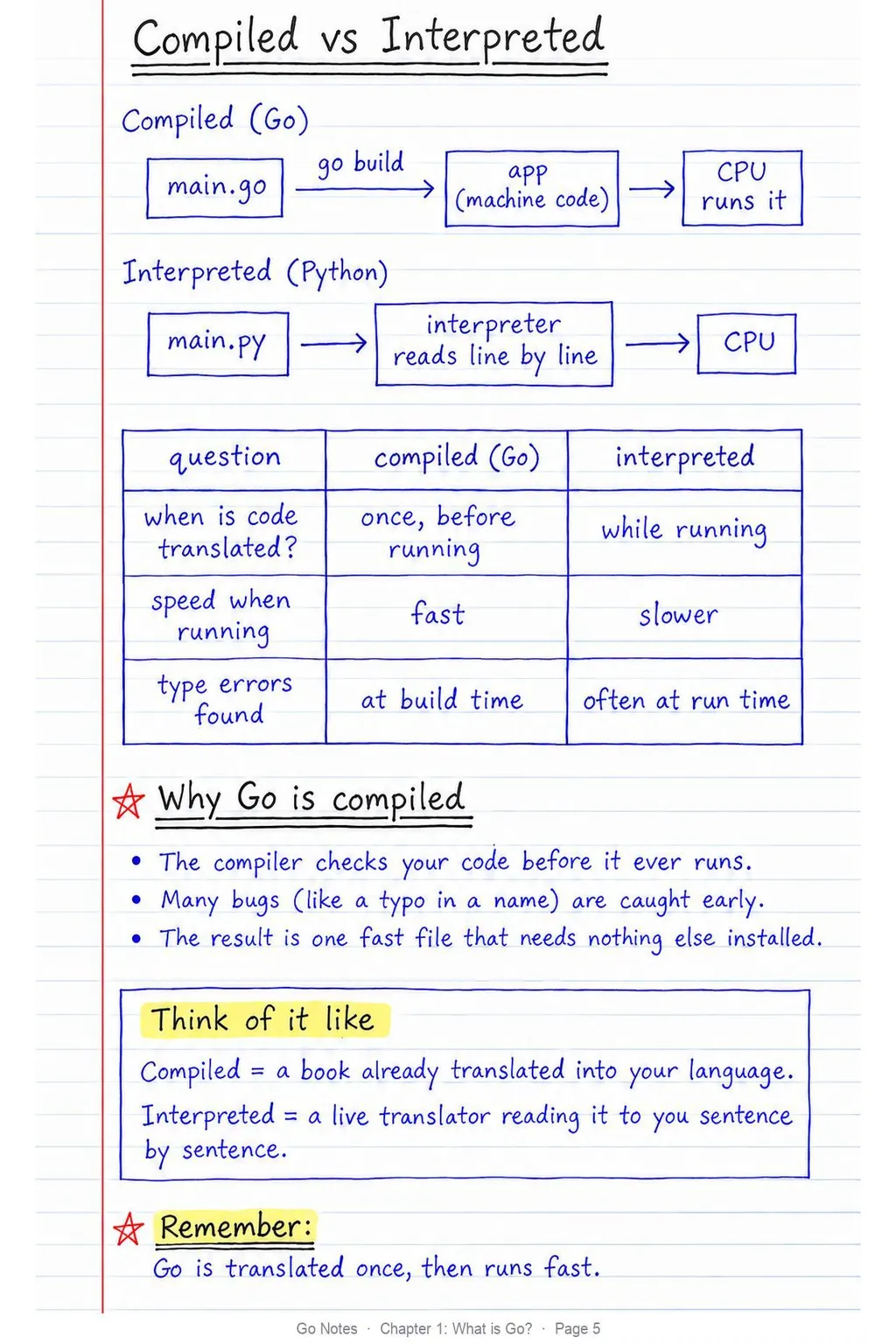
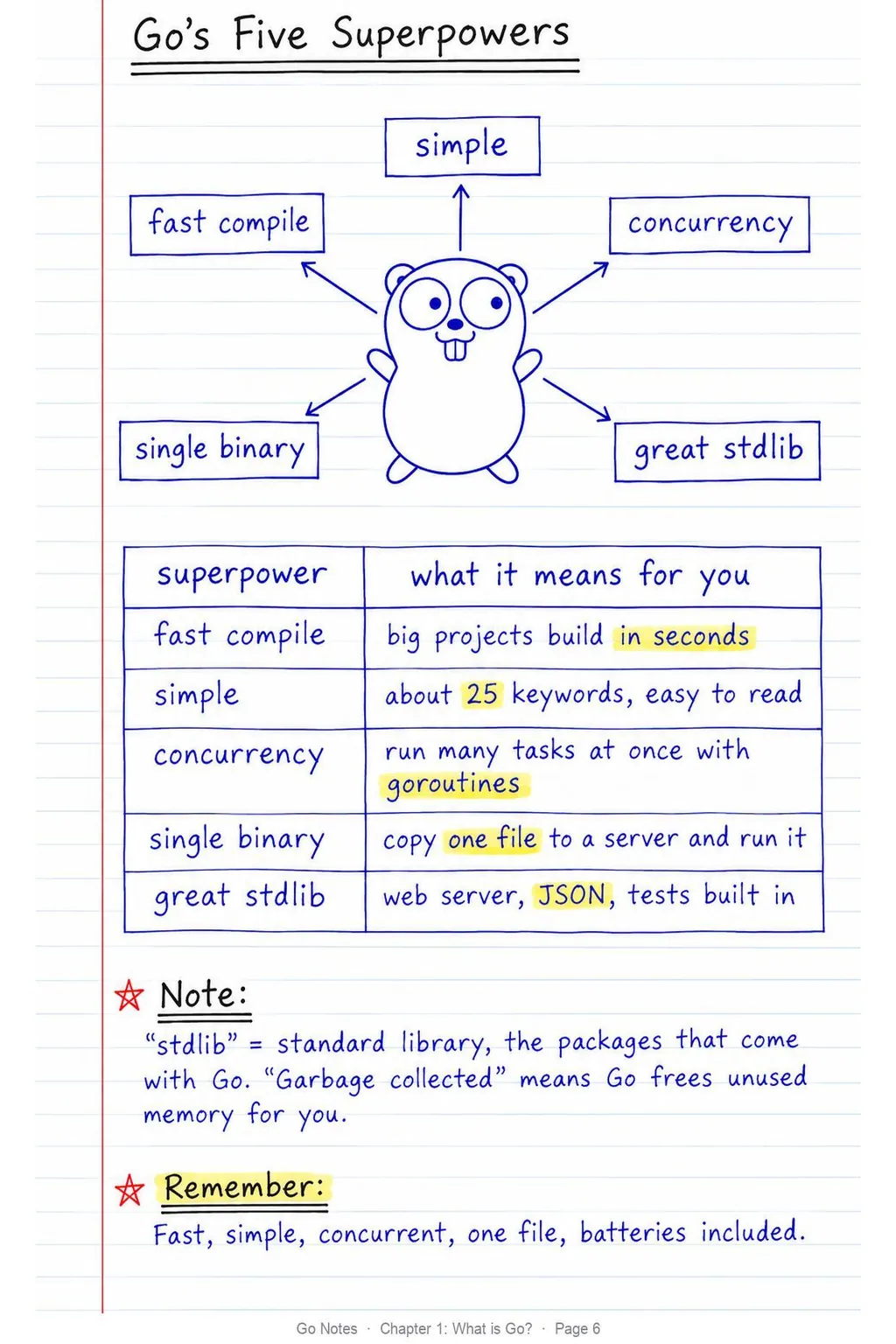
Learn what Go is and why it exists: compiled versus interpreted, Go's five superpowers, where Go is used and how it compares with Python, Java and Rust.
Get set up and run your first program: installing Go, go mod init, Hello World line by line, go run versus go build, helper tools and how a Go program starts.
Store data with variables, types and constants: var versus :=, basic types, zero values, manual type conversion, constants and iota, a first look at strings, bytes and runes, fmt printing, scope and shadowing.
Control program flow with operators and loops: if and else with the short statement, the three-part for loop, for as while, range, switch, break, continue and labels.
Write functions: multiple return values, named returns, variadic functions, functions as values, closures, recursion and defer with its last-in-first-out order.
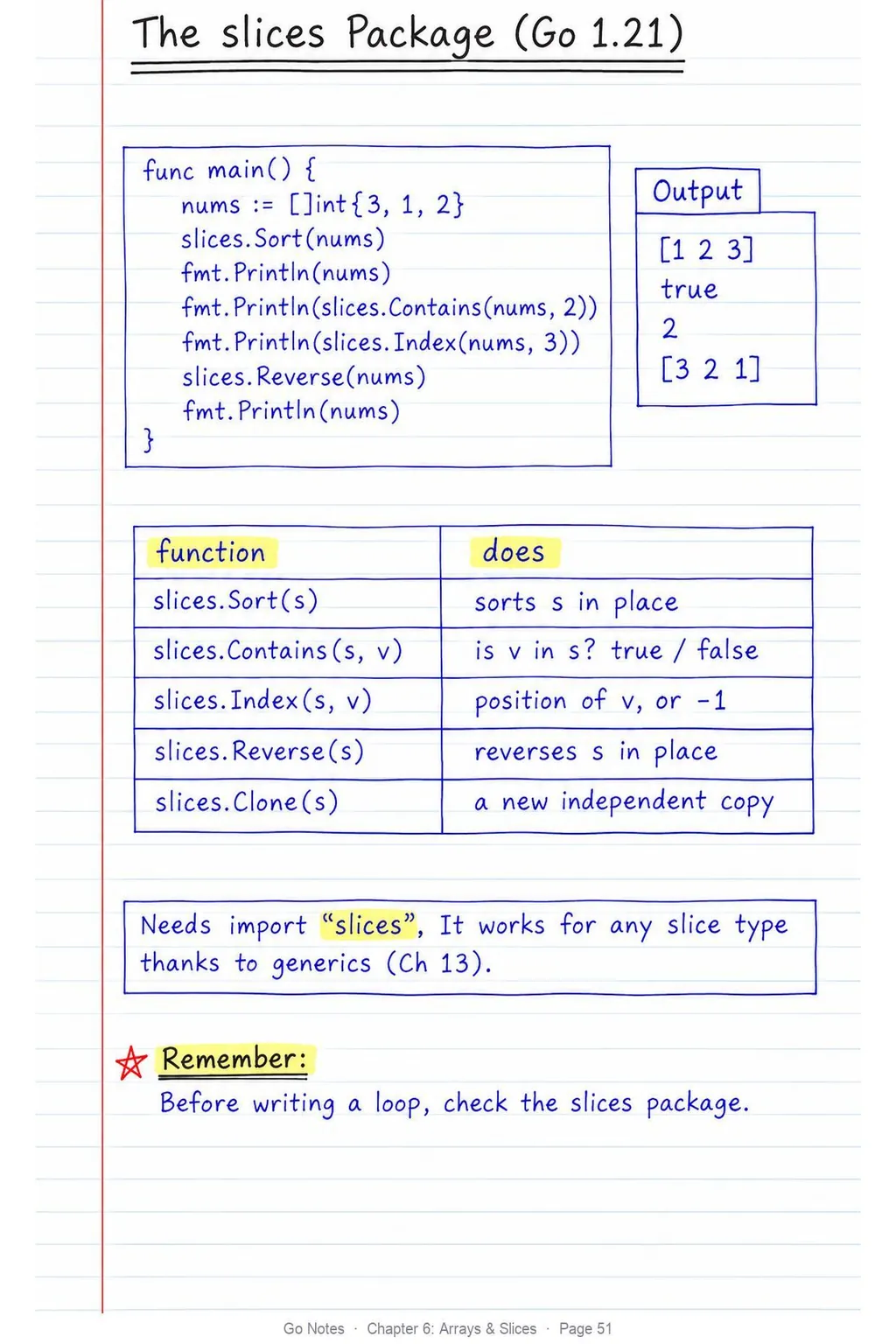
Work with arrays and slices: what a slice really is, literal, make and nil slices, append and growth, shared memory when slicing, copy, full slice expressions, 2D slices and the slices package.
Use maps to look things up by key: adding, updating and deleting, the comma-ok idiom, random iteration order, the nil map trap, maps of structs, sets and the maps package.
Go deeper with strings: read-only bytes, UTF-8 bytes versus runes, the strings package, strings.Builder for fast text building and strconv for converting between strings and numbers.
Group data with structs: fields and comparison, pointers to structs, NewX constructor functions, embedding for composition instead of inheritance, anonymous structs and struct tags.
Understand pointers: addresses in memory, & and * step by step, pass by value versus pass by pointer, new, pointers to structs, nil pointers and when to use pointers.
Attach behaviour to types and use interfaces: methods, value versus pointer receivers, automatic satisfaction, decoupling, the nil trap, any, type assertions and switches, Stringer, io.Reader and io.Writer.
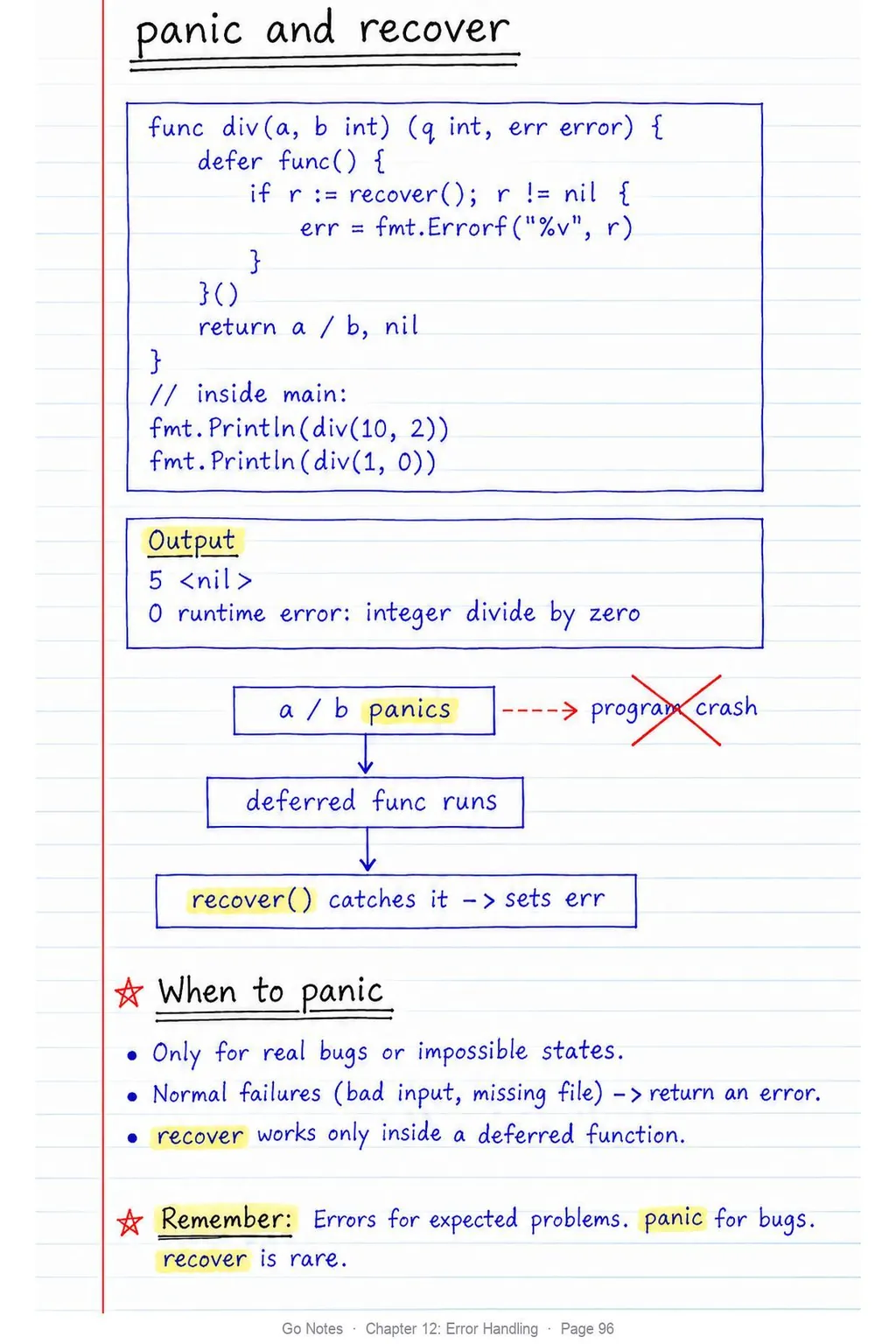
Handle errors the Go way: errors as values, errors.New and fmt.Errorf, wrapping with %w, errors.Is and errors.As, custom error types, sentinel errors, panic and recover, errors.Join and best practices.
Write reusable code with generics: the problem they solve, function syntax, constraints such as any, comparable and cmp.Ordered, custom constraints with ~ and unions, generic types like Stack of T and type inference.
Organise code into packages and modules: exported versus unexported names, go.mod and go.sum, go get and go mod tidy, internal packages, semantic versioning and /v2, init, import cycles and go work.
Start running work concurrently: concurrency versus parallelism, the go keyword, the scheduler with G, M and P, sync.WaitGroup, wg.Go in Go 1.25 and goroutine cost and leaks.
Pass data between goroutines with channels: unbuffered and buffered channels, channel directions, close and range, select, timeouts with time.After and a cheat table of channel rules.
Share memory safely: the race condition, sync.Mutex, sync.RWMutex, sync.Once, sync/atomic counters and the race detector with -race.
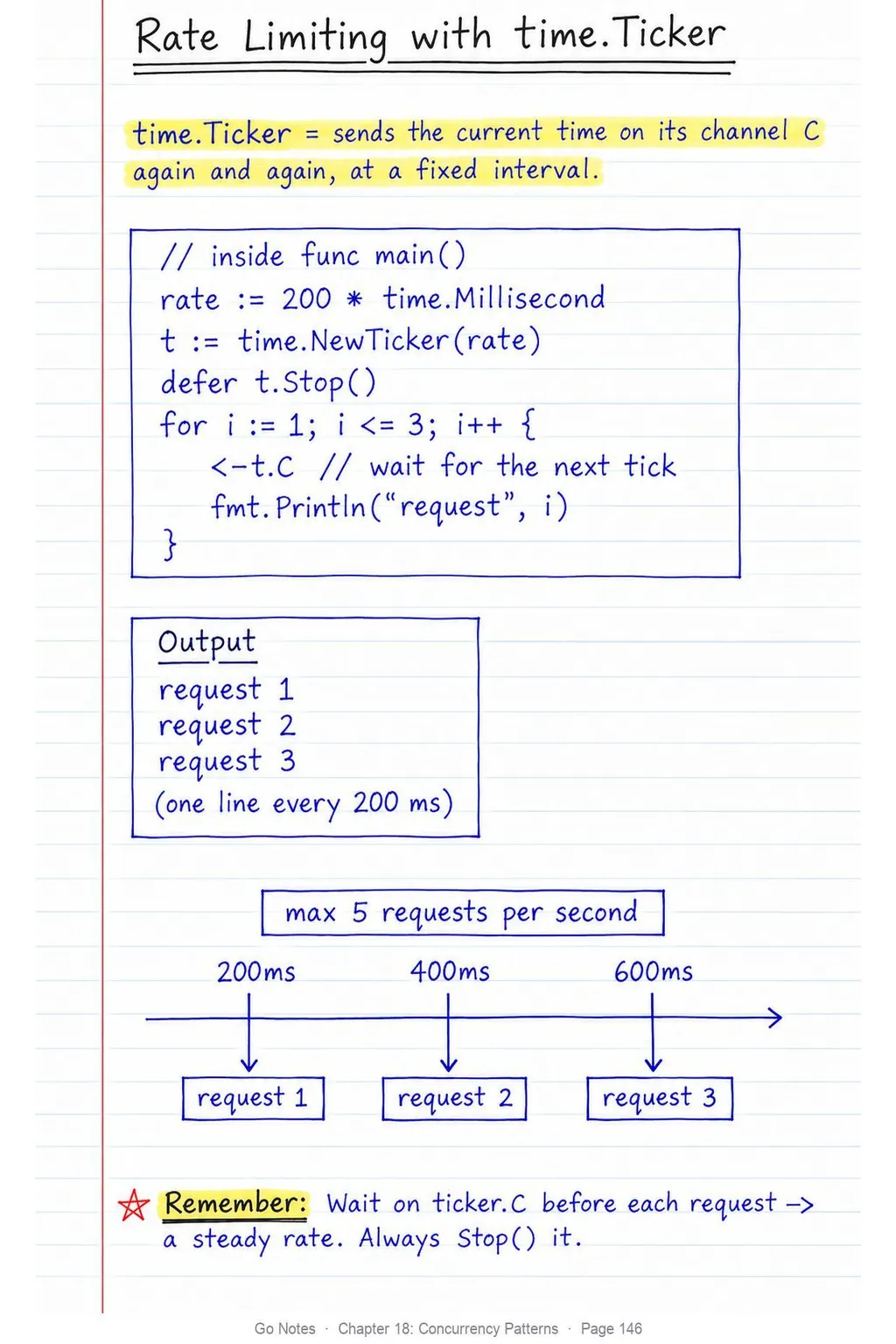
Apply concurrency patterns: worker pools, pipelines, fan-out and fan-in, errgroup, a semaphore built from a buffered channel, rate limiting with time.Ticker and choosing between channels and mutexes.
Control goroutine lifetimes with context: why context exists, WithCancel, WithTimeout and WithDeadline, using context in HTTP handlers and database calls and the rules to follow.
Read and write files: io.Reader and io.Writer, os.ReadFile and os.WriteFile, os.Open with defer Close, bufio.Scanner, bufio.Writer, paths and directories and embed.
Work with JSON: json.Marshal, struct tags for field names, json.Unmarshal, unknown JSON with map[string]any and streaming with json.Encoder and json.Decoder.
Cover everyday standard-library tasks: time, durations and formatting with the reference date, timers and tickers, structured logging with log/slog, command-line flags, os.Args, environment variables and os/exec.
Test your Go code: go test, table-driven tests, subtests with t.Run, t.Helper, t.Fatal, t.Errorf and t.Cleanup, coverage, benchmarks with b.Loop, fuzzing and testing HTTP handlers with httptest.
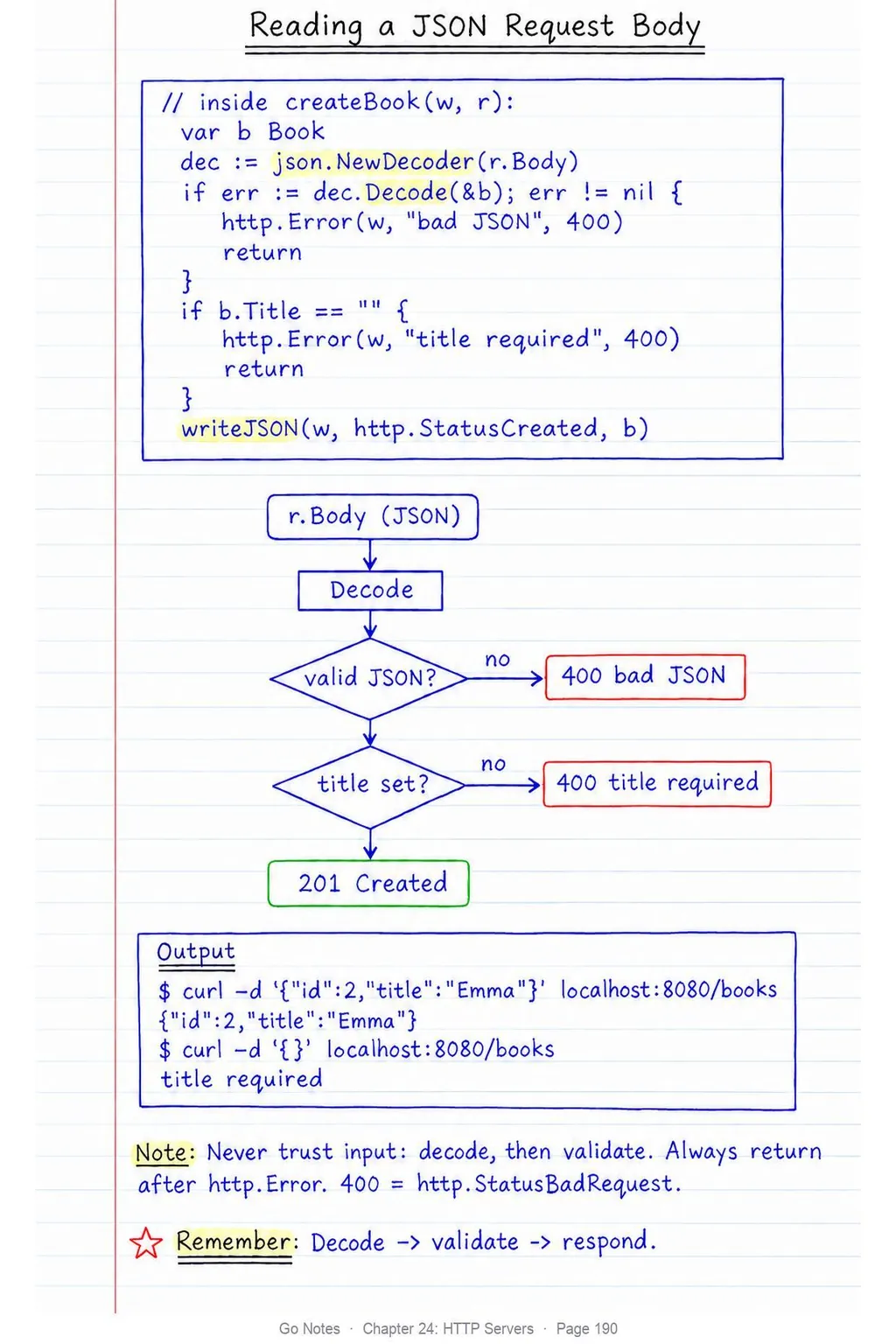
Build HTTP servers: how a web server works, handlers and http.HandlerFunc, routing with methods and {id} wildcards, JSON responses, reading JSON bodies, middleware, http.Server timeouts and graceful shutdown.
Call other services with HTTP clients: http.Get, always using a client with a timeout, POSTing JSON with NewRequestWithContext, checking status codes and retrying with care.
Use databases with database/sql: opening a database, QueryRowContext and Scan, QueryContext and the rows.Next loop, ExecContext with placeholders to avoid SQL injection, transactions and pool settings.
Build the Bookly REST API from scratch: the Book model and Store interface, an in-memory store with a mutex, handlers, routing and middleware, wiring main.go, graceful shutdown and testing with httptest.
Build command-line tools: the anatomy of a CLI, subcommands with flag.NewFlagSet, the Cobra library for bigger tools, go install and cross-compiling.
Build microservices with gRPC: REST versus gRPC, Protocol Buffers and the .proto file, generating Go code with protoc, filling in the server interface, starting the server and writing a client.
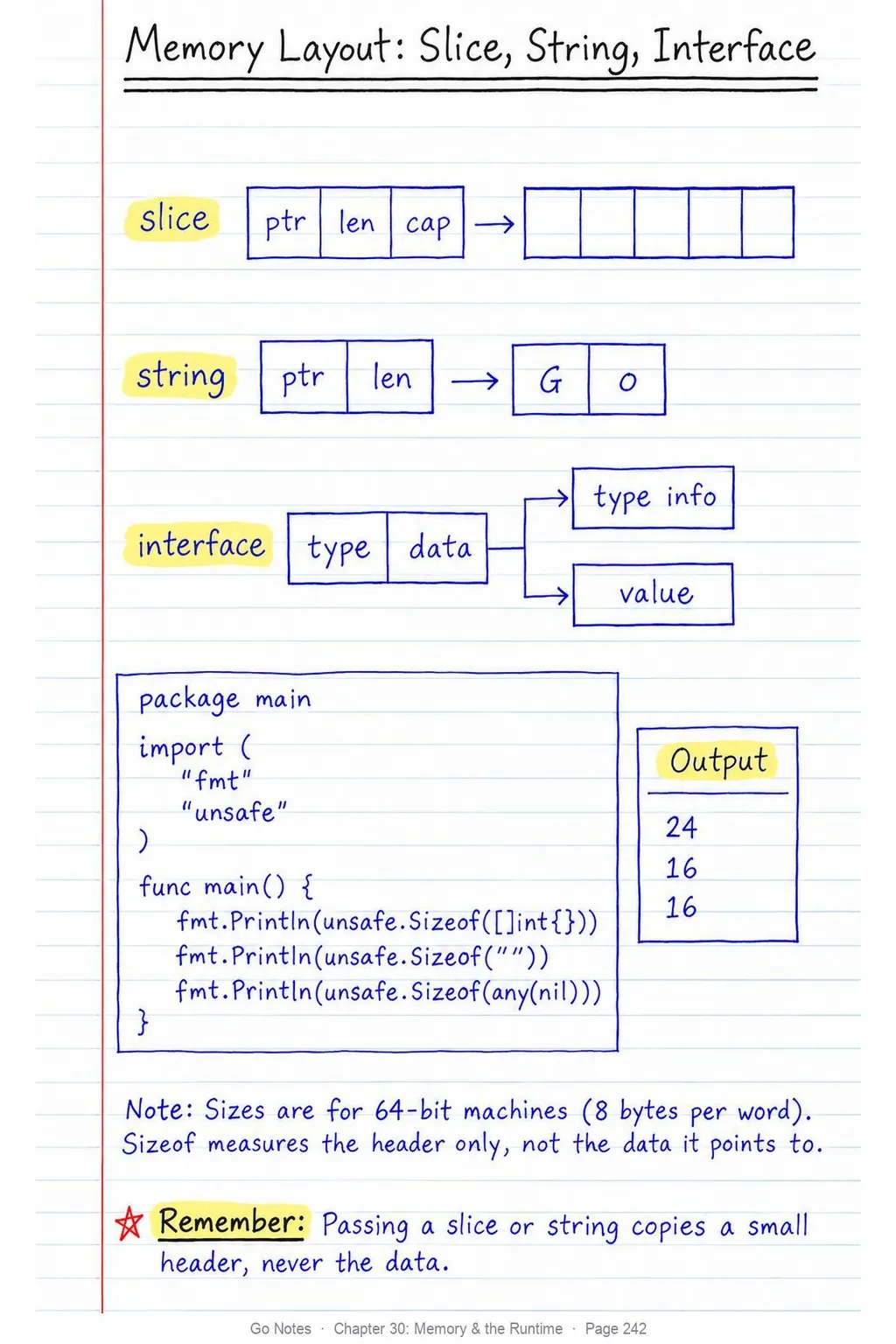
Look under the hood of the runtime: stack versus heap, escape analysis, the tri-color garbage collector, tuning with GOGC and GOMEMLIMIT, memory layout, scheduler work stealing and struct field alignment.
Make your programs faster: benchmarks with -benchmem, CPU and heap profiles, fewer allocations, reusing objects with sync.Pool, runtime/trace and profile-guided optimisation.
Keep your code clean with Go tooling: gofmt and goimports, go vet, staticcheck and golangci-lint, go doc and doc comments, build tags, cross compilation, go generate and go tool.
Ship your Go program: one static binary, Docker multi-stage builds, scratch versus distroless versus alpine, config from environment variables and observability with logs, metrics and health checks.
Think in idiomatic Go and prepare for interviews: Go proverbs, project layout conventions, the top 10 mistakes, interview Q&A on data, concurrency, errors, runtime and generics, cheat sheets and a learning roadmap.
Watch before you buy
Students on All Notes PDF
Real students talking about how they revise with our handwritten notes.
How it works
Get your notes in 3 easy steps
No app, no waiting. The whole thing takes under a minute.
- STEP 110 sec
Choose your notes
One subject, any two, or a full class set.
- STEP 230 sec
Pay with UPI or card
GPay, PhonePe, Paytm or card. Pay once, no subscription.
- STEP 3Instant
Download your PDFs
Tap Download on any chapter. Links never expire.
- Log in
- My library
- Download
What you get
- Format
- Downloadable PDF (not a printed book)
- Chapters
- 34 chapters in one 275 page PDF
- Level
- Go from beginner to advanced. No experience needed
- Style
- Handwritten-style notes with diagrams, code explained line by line, common mistakes and quizzes
- Devices
- Phone, tablet and laptop. Print any chapter if you like
- Access
- Lifetime. Download again anytime from My library
- Instant downloadRight after payment
- Free updatesCorrections added free
- Secure paymentUPI, cards, net banking