Tech · Beginner to Advanced · Handwritten PDF notes
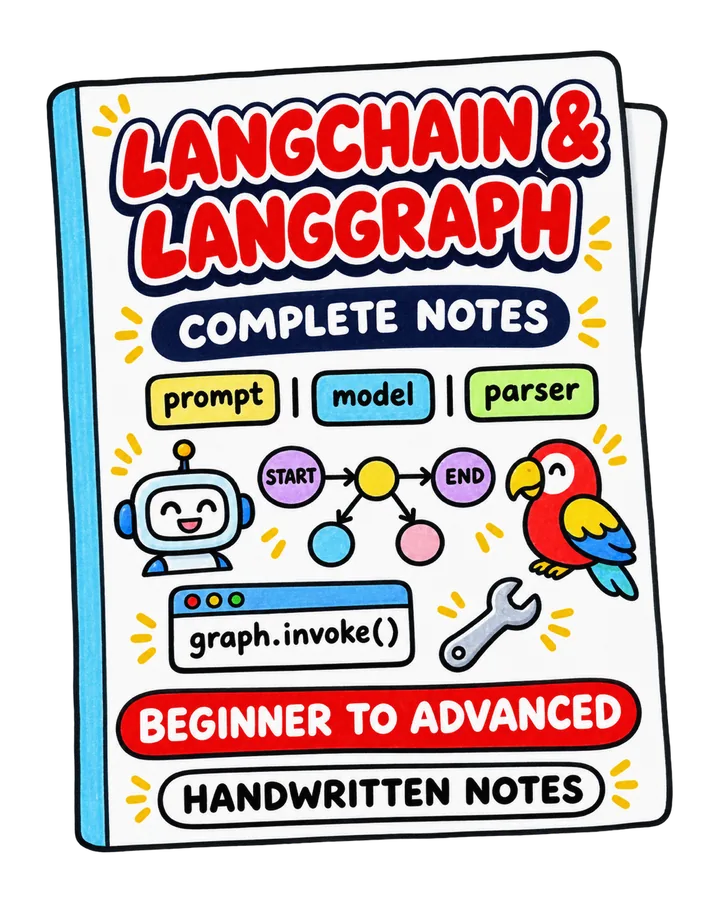
LangChain & LangGraph Complete Notes
Instant PDF download after payment. Pay once, keep forever.
- Instant download
- Lifetime access
- UPI, GPay, PhonePe, cards
Complete coverage
What you learn in all 32 chapters
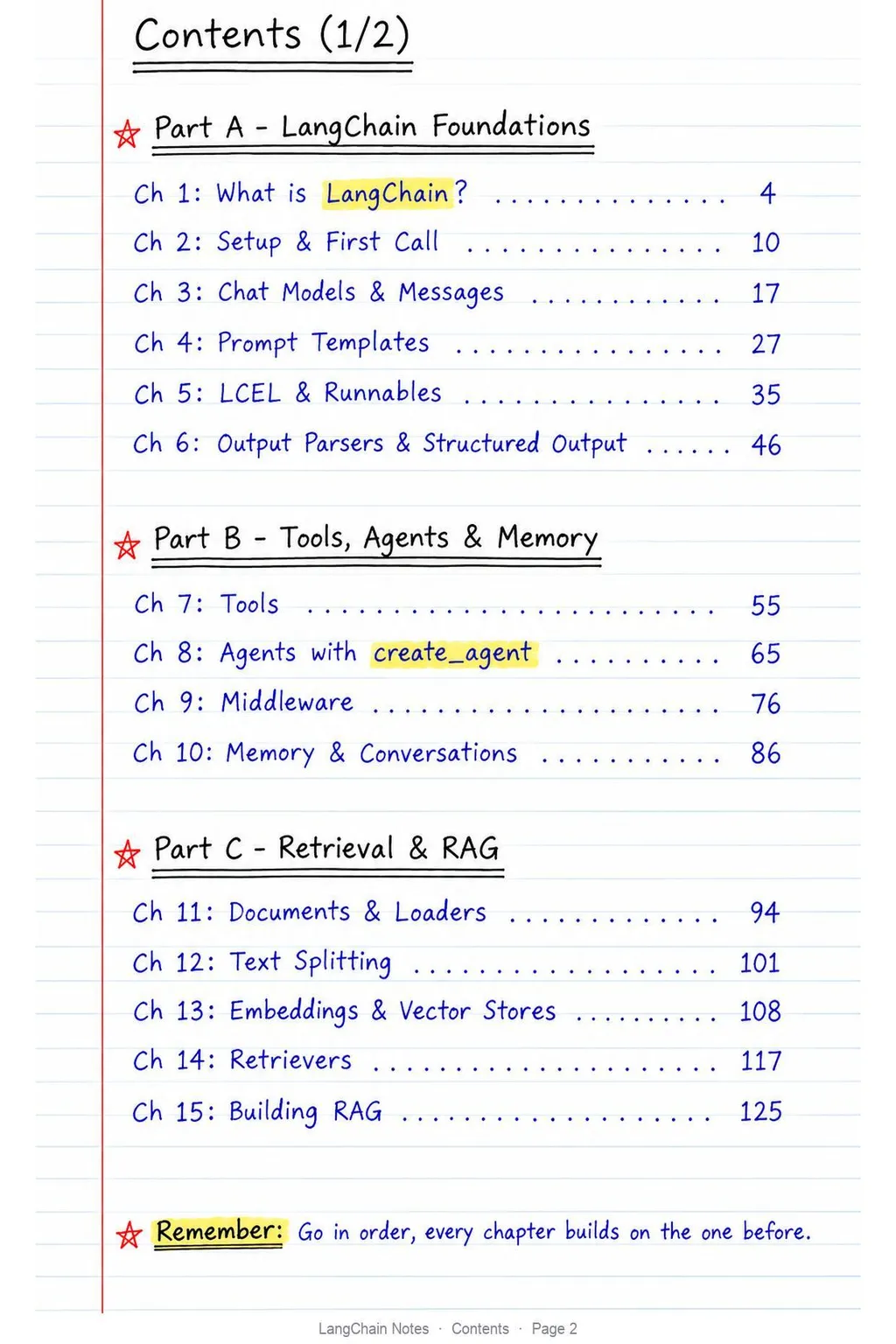
Open any chapter to see every topic it covers and the page it is on.
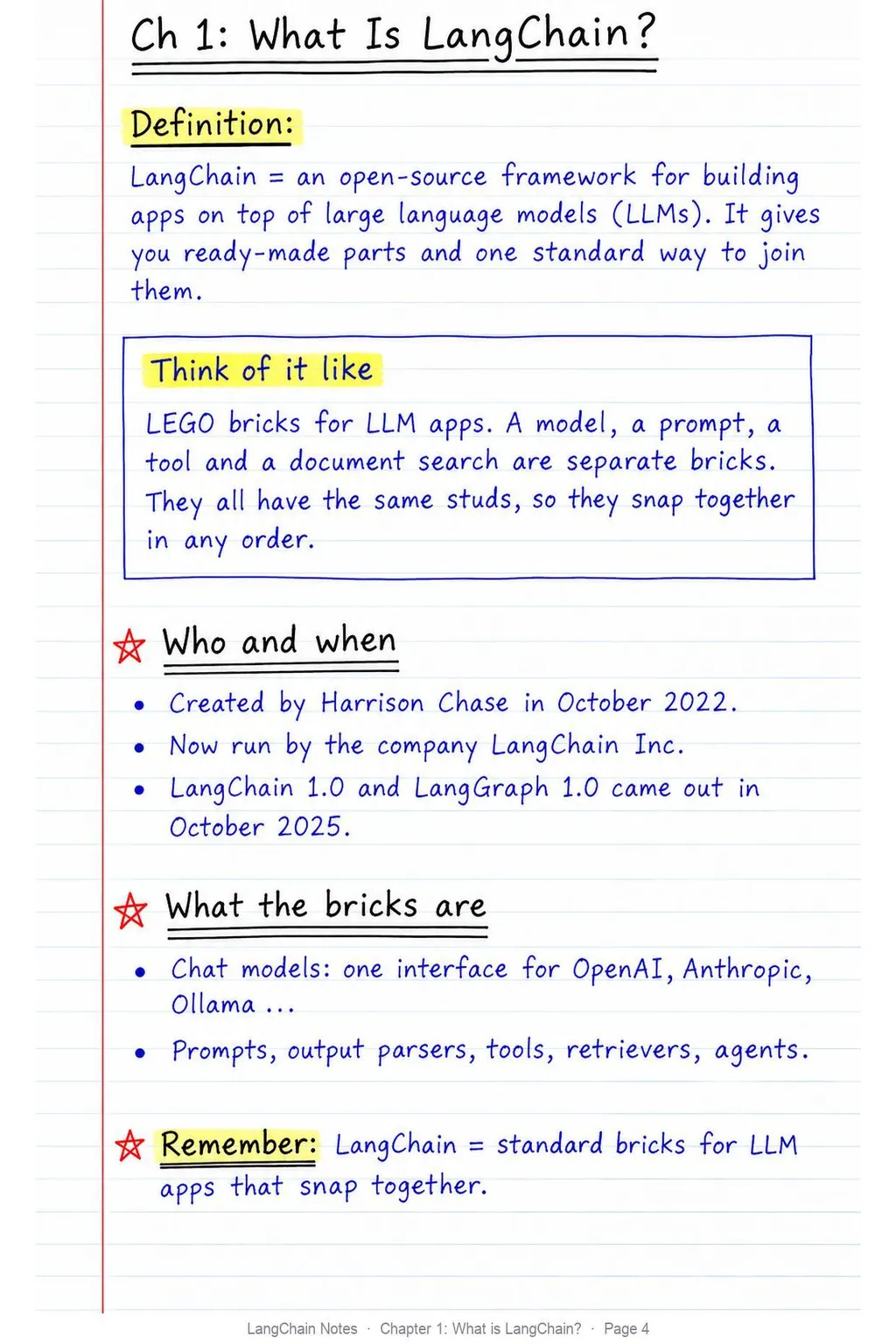
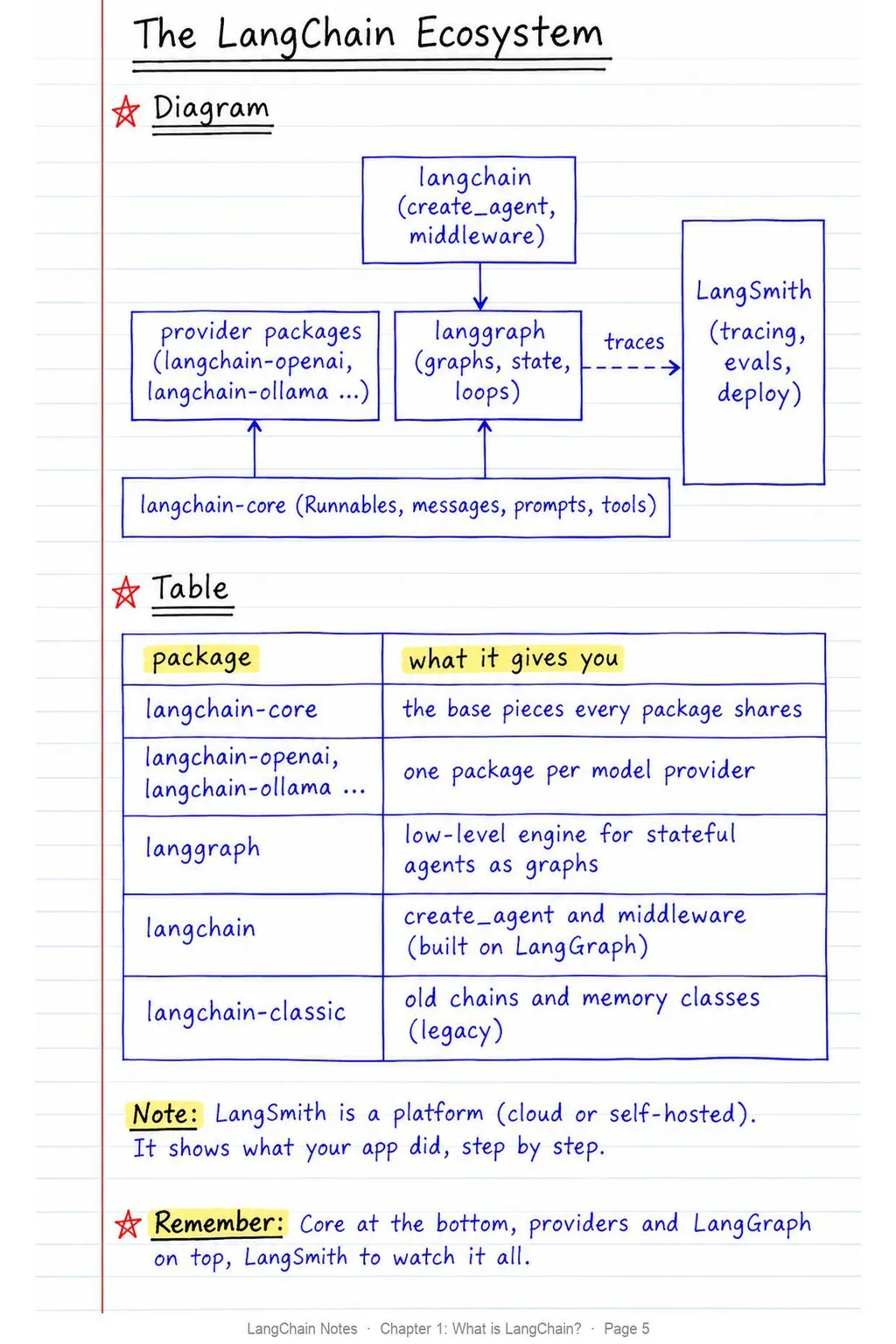
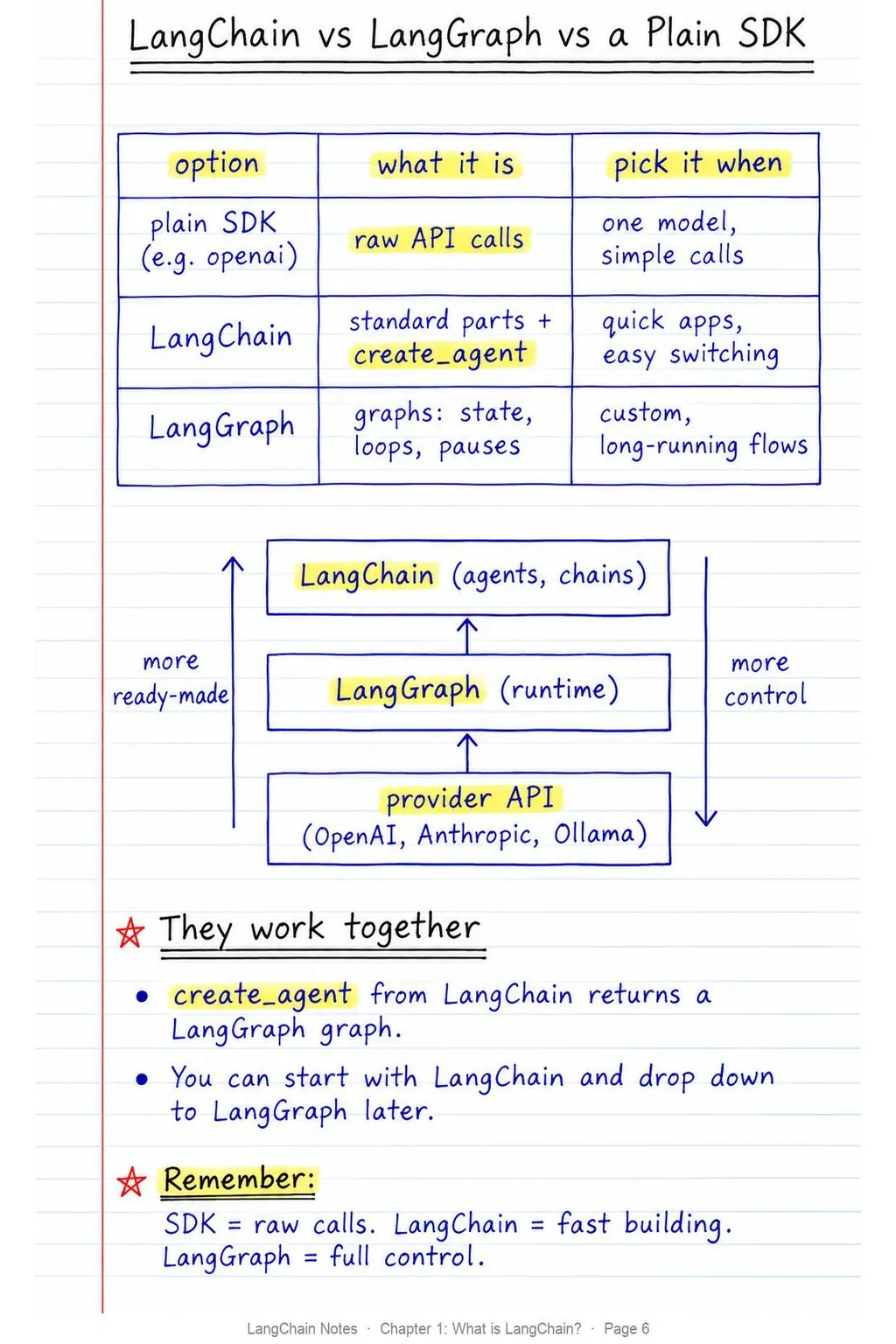
Understand what LangChain is for: the LangChain ecosystem, how it differs from LangGraph and a plain SDK, what you can build, and DocuBot, the running example.
Set up and make your first call: install LangChain and provider packages, store API keys in a .env file, run locally for free with Ollama, use init_chat_model, and see what changed in v1.
Talk to models through one interface: the four message types, invoke, streaming, batch, model parameters, switching providers with init_chat_model, what is inside an AIMessage, and async with ainvoke and astream.
Write reusable prompts: PromptTemplate and ChatPromptTemplate, MessagesPlaceholder for chat history, partial variables, few-shot chat prompts and keeping prompts in files.
Compose steps with LCEL: the Runnable interface, the pipe operator, the classic prompt | model | parser chain, RunnableLambda, RunnablePassthrough, RunnableParallel, routing, retries and fallbacks, config and streaming.
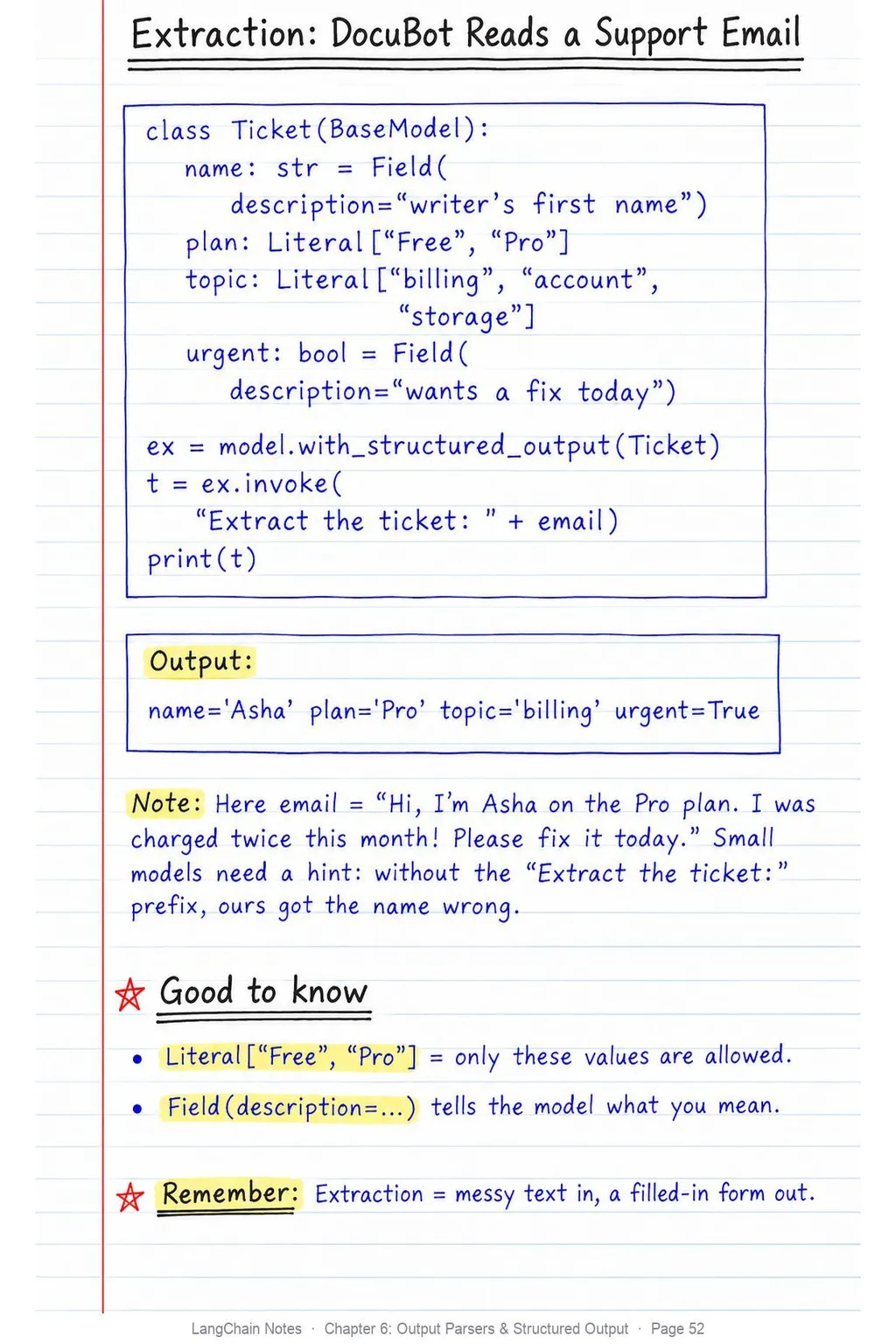
Get reliable structured data from a model: StrOutputParser, with_structured_output using Pydantic, TypedDict and JSON Schema, JsonOutputParser, include_raw, plus extraction and classification with DocuBot.
Give a model tools: the @tool decorator, the schema the model sees, args_schema, bind_tools, reading tool_calls, sending a ToolMessage, ToolRuntime, and good tool design with error handling.
Build agents with create_agent: the ReAct pattern, reading the message trace, system_prompt, several tools, response_format, streaming steps, context_schema, and how it compares with older agent APIs.
Control agent behavior with middleware: built-in middleware, summarization, human in the loop, call limits, PII protection, fallbacks and retries, and custom hooks like @before_model, @after_model, @wrap_model_call and @dynamic_prompt.
Give your agents memory: why LLMs forget, short-term memory with a checkpointer and thread_id, InMemorySaver, separate threads, trim_messages, summarizing old messages and long-term memory with a store.
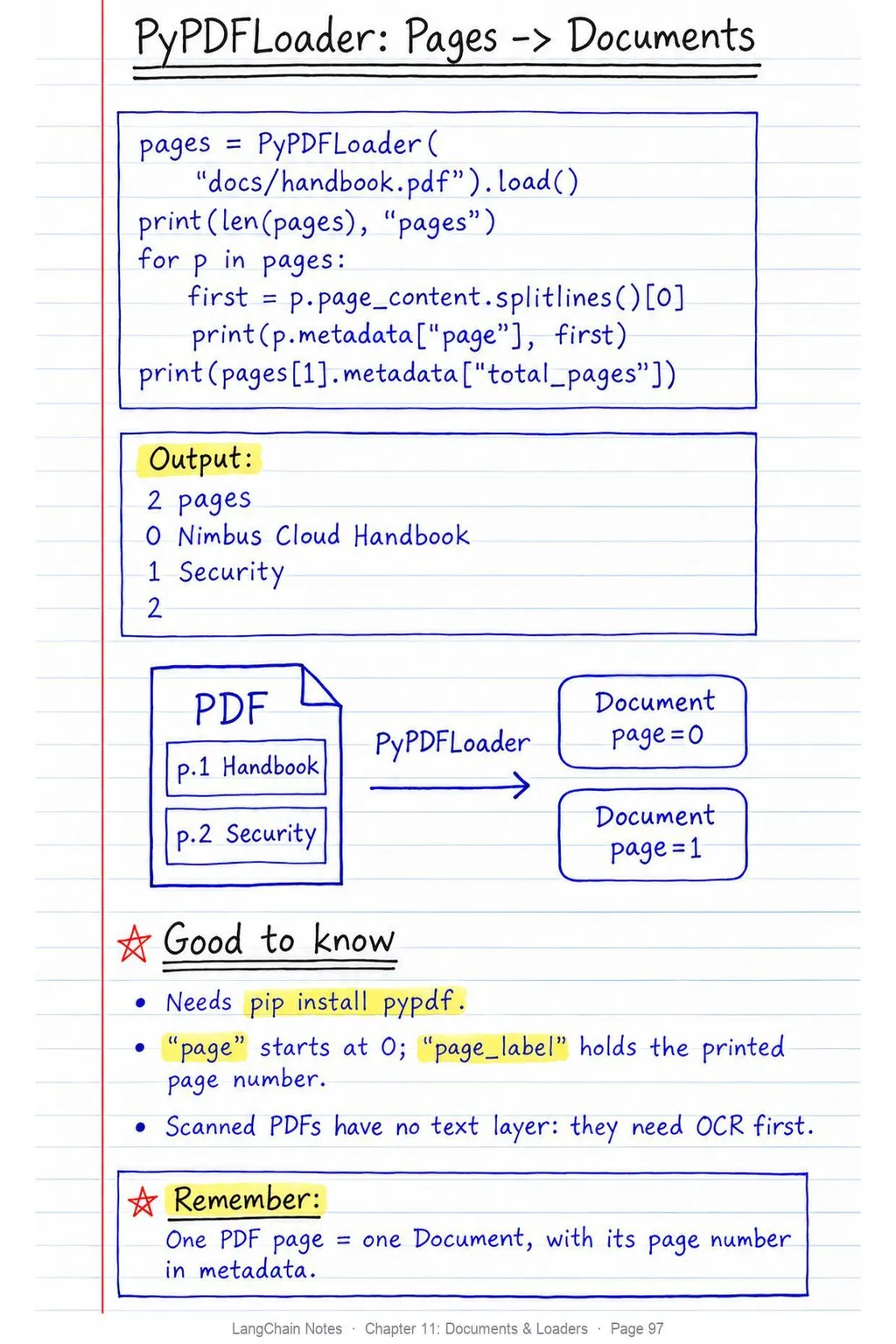
Load your data as Documents: the Document object, document loaders, TextLoader, DirectoryLoader, PyPDFLoader, WebBaseLoader, metadata and lazy_load.
Split documents into good chunks: why splitting matters, RecursiveCharacterTextSplitter, chunk_size and chunk_overlap, splitting real documents, Markdown and code splitters, and token-based splitting.
Turn text into searchable vectors: embeddings, OllamaEmbeddings, cosine similarity, the vector store idea, InMemoryVectorStore, Chroma, FAISS, scores and metadata filters.
Fetch the right chunks: the retriever interface, similarity versus MMR, BM25, hybrid search with EnsembleRetriever, multi-query retrieval, parent-document retrieval, contextual compression and reranking.
Build RAG end to end: index the DocuBot docs, retrieve then prompt then answer with LCEL, format documents, cite sources, try agentic and conversational RAG, and learn failure modes and answer checks.
See why LangGraph exists: where chains stop, a graph as state plus nodes plus edges, key concepts at a glance, when to use create_agent or your own graph, and Graph API versus Functional API.
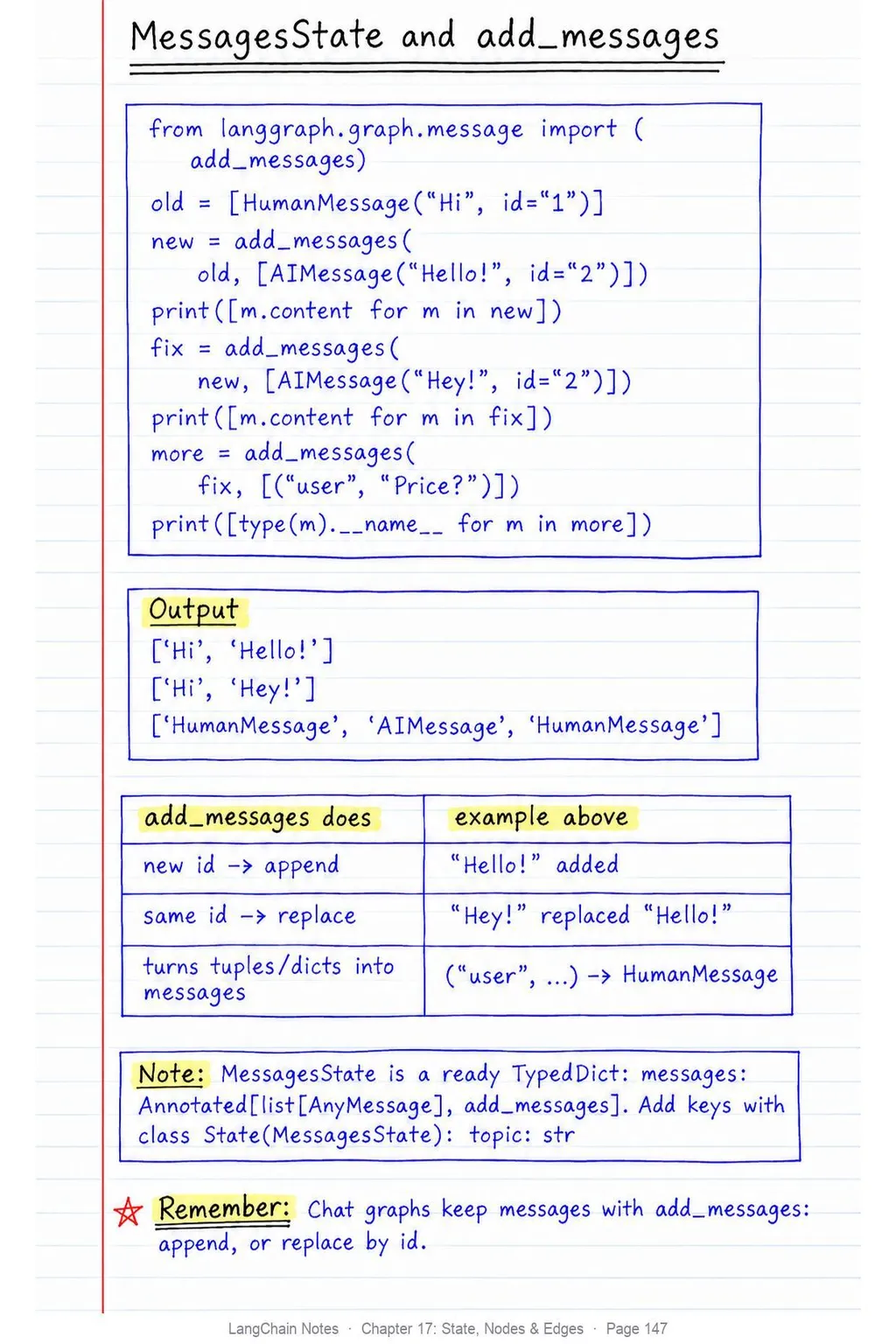
Build graphs from state, nodes and edges: TypedDict state, partial updates, StateGraph, START and END, compile and invoke, drawing the graph, reducers, MessagesState, input and output schemas, and the DocuBot Greeter.
Control the flow of a graph: conditional edges and routers, the DocuBot triage example, loops with exit conditions, recursion_limit, Command, parallel fan-out and fan-in, and map-reduce with Send.
Build an agent from scratch in LangGraph: state and tools, the llm node with bind_tools, ToolNode, tools_condition, a real trace, a system prompt, and how your graph compares with create_agent.
Save and replay graph runs: checkpoints along a thread, InMemorySaver, get_state and get_state_history, time travel, update_state to fork, SqliteSaver and production checkpointers like Postgres.
Put a human in the loop: interrupt() inside a node, resuming with Command(resume=...), approving, editing or rejecting a tool call, HumanInTheLoopMiddleware, static breakpoints and design patterns.
Stream results as they happen: the stream modes, updates and values, token streaming with the messages mode, custom events with get_stream_writer, and combining modes with subgraphs.
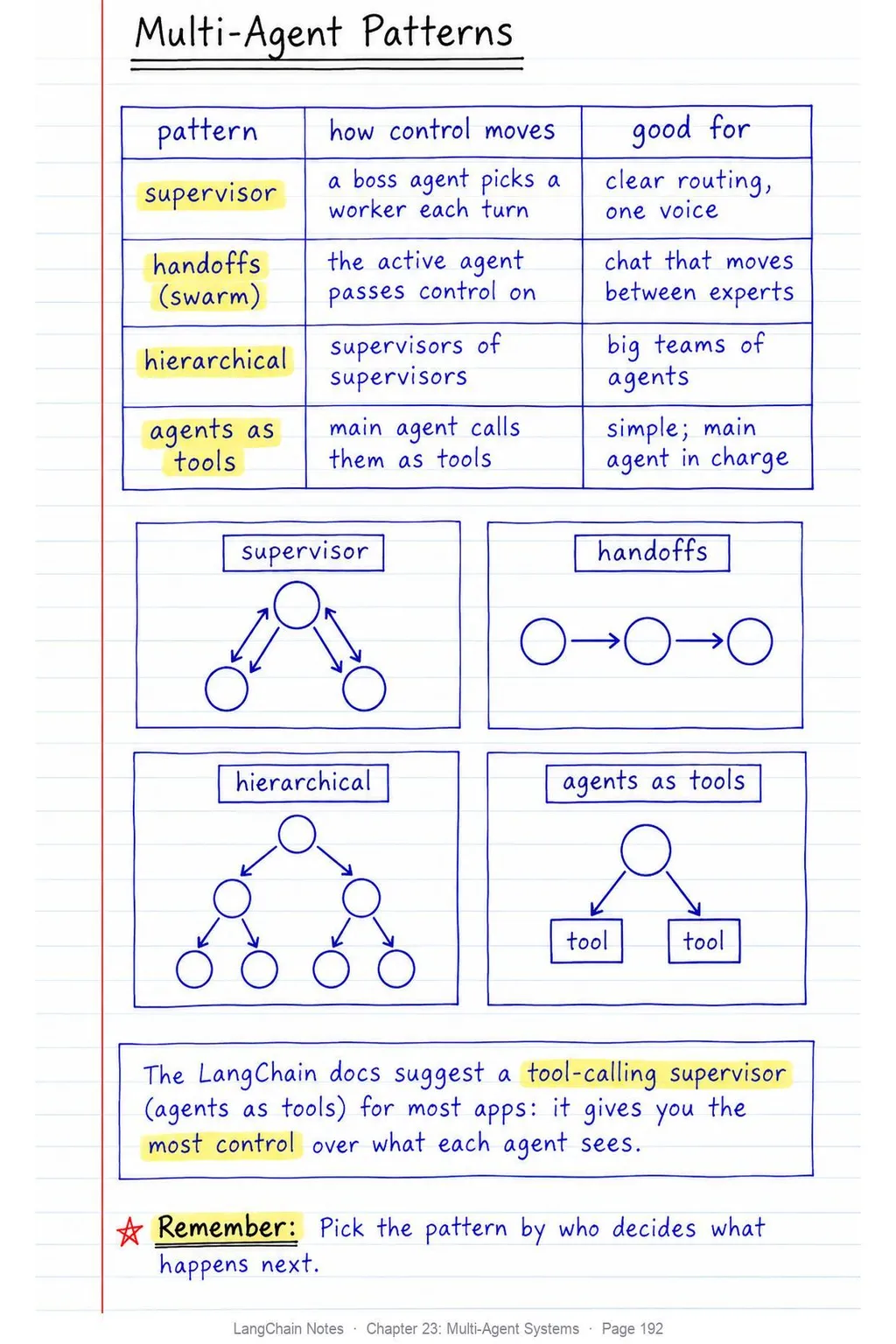
Coordinate several agents: when to use many agents, common patterns, subgraphs as nodes, agents as tools, the supervisor pattern and code, handoffs with Command, shared versus private state, and langgraph-supervisor.
Go further with the Functional API and advanced graphs: @entrypoint and @task, a worked example, durable execution, RetryPolicy, node caching, runtime context and the long-term memory store.
Connect to outside tools with MCP: how MCP works, write a tiny server with FastMCP, load tools with MultiServerMCPClient, use them in an agent, and tour the integrations ecosystem.
Trace and debug with LangSmith: what it is, turning on tracing, reading a trace tree, @traceable for your own functions, tags, metadata and projects, and a debugging checklist.
Test your apps with evaluation: vibes versus tests, datasets of examples, evaluators, a local eval with pytest, evaluate() in LangSmith, RAG metrics and agent trajectory evaluation.
Deploy your app: deployment options, serving a chain with FastAPI, a streaming SSE endpoint, langgraph.json, langgraph dev and Studio, LangSmith Deployment, Docker and config, and secrets.
Prepare for production: track cost and tokens, cache model calls, rate limit, use fallbacks, retries and timeouts, add guardrails against prompt injection, test with fake models and follow a production checklist.
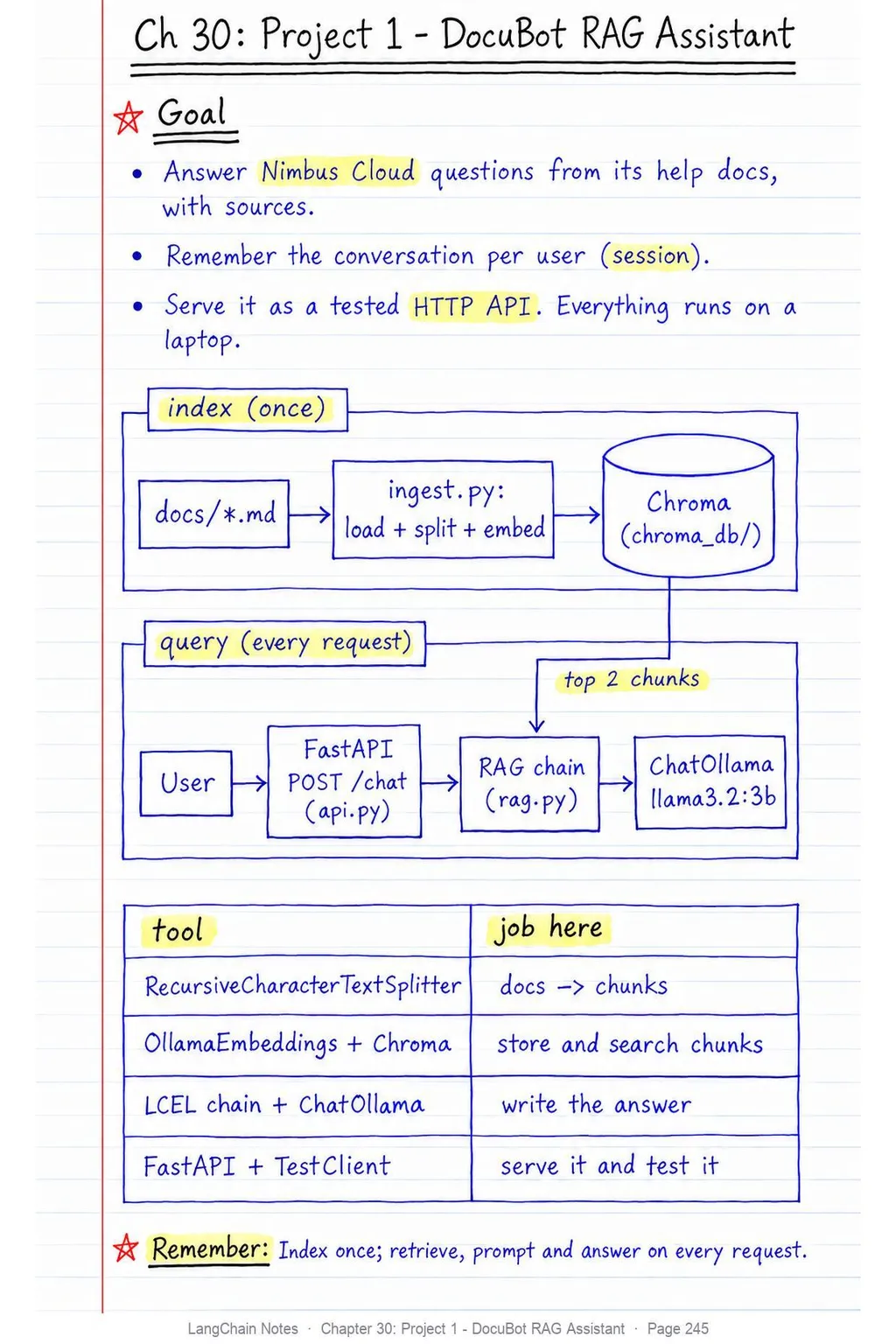
Build Project 1, the DocuBot RAG assistant: project layout, the Nimbus docs, ingest with load, split and embed into Chroma, the RAG chain, sources, chat memory, a FastAPI endpoint, tests, a small evaluation and a run checklist.
Build Project 2, a research agent with LangGraph: state, a planner node with structured output, a search tool, researcher and writer nodes, human review with interrupt(), checkpointer and threads, streaming progress and a run checklist.
Prepare for interviews and plan what next: Q&A on LangChain, tools, RAG, LangGraph, multi-agent and production, an imports cheat sheet, the top 10 mistakes, a learning roadmap and the whole stack on one page.
Watch before you buy
Students on All Notes PDF
Real students talking about how they revise with our handwritten notes.
How it works
Get your notes in 3 easy steps
No app, no waiting. The whole thing takes under a minute.
- STEP 110 sec
Choose your notes
One subject, any two, or a full class set.
- STEP 230 sec
Pay with UPI or card
GPay, PhonePe, Paytm or card. Pay once, no subscription.
- STEP 3Instant
Download your PDFs
Tap Download on any chapter. Links never expire.
- Log in
- My library
- Download
What you get
- Format
- Downloadable PDF (not a printed book)
- Chapters
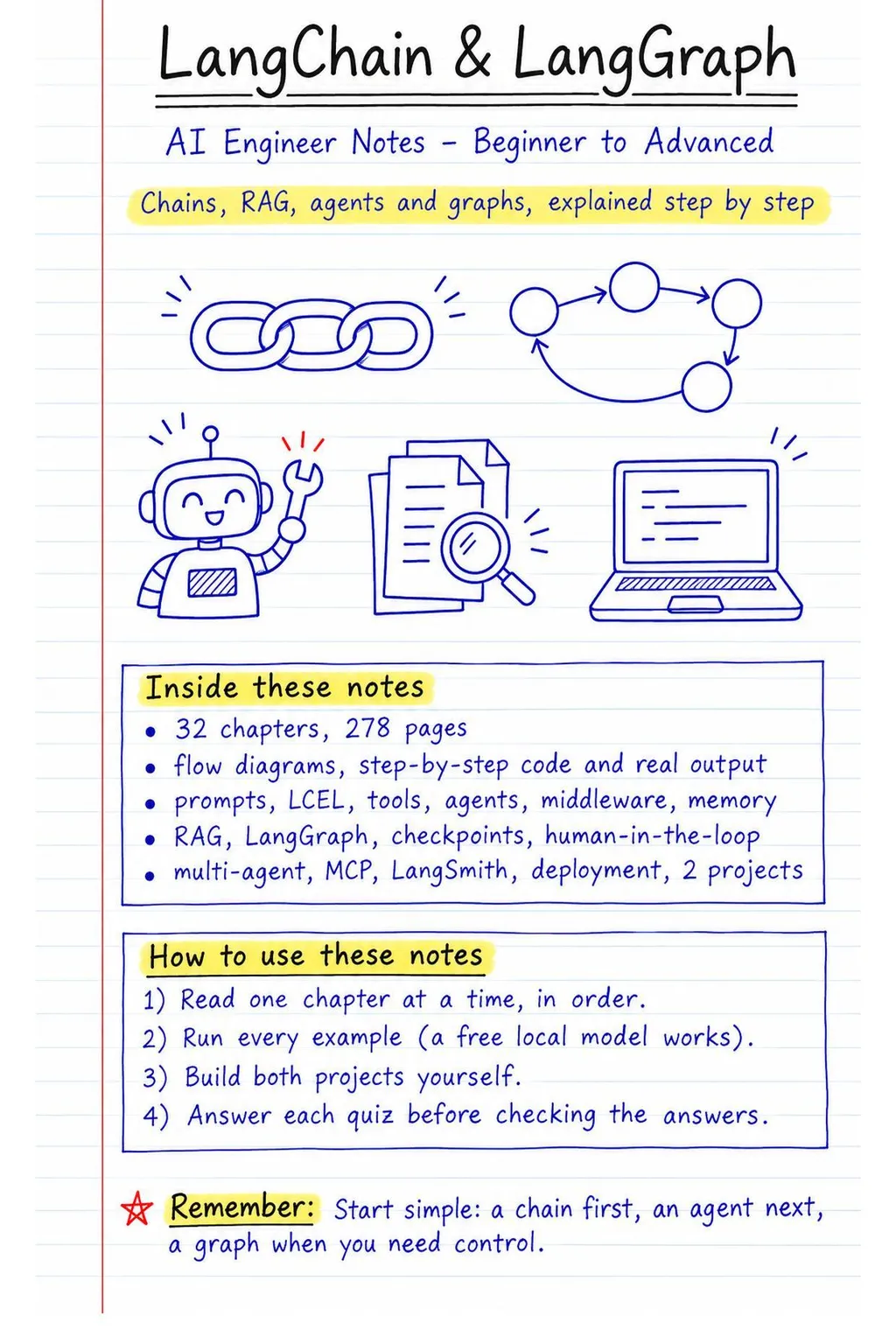
- 32 chapters in one 278 page PDF
- Level
- LangChain & LangGraph from beginner to advanced. No experience needed
- Style
- Handwritten-style notes with diagrams, code explained line by line, common mistakes and quizzes
- Devices
- Phone, tablet and laptop. Print any chapter if you like
- Access
- Lifetime. Download again anytime from My library
- Instant downloadRight after payment
- Free updatesCorrections added free
- Secure paymentUPI, cards, net banking